Tech
Talk
|
By Scott H.
First, a little exhaust education. Exhaust
technology is the reason two-stroke engines work. Volumes have been written
about the principles governing expelling gases out of the beloved internal
combustion engines - space will force me to be brief. There are three things
we can tune for an exhaust: the sonic pulse; the thermal pulse; and gas
velocity. The length of the pipe controls the first two, but gas velocity is
controlled by the pipe diameter. A sonic pulse is created when the exhaust valve
slams shut and a strong wave is made that starts down the pipe. When it
reaches the end, it turns around and heads back to the combustion chamber.
The hot gas leaving the combustion chamber creates the thermal pulse. It,
too, travels to the end of the pipe and sends the wave back up to the
combustion chamber. It would nice if the sonic pulse and the thermal pulse
reacted at the same speed, but they don't. When tuning, you usually have to
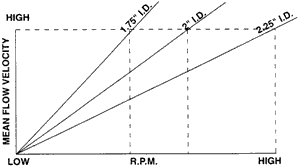
choose one or the other to optimize. Ideal gas velocity is 300 feet per minute and a
variety of factors influence this important goal. Remember, too fast is as
bad as too slow. Without going into the math involved, the 883's, 1200's and
1340's need a 1 3/4" pipe to stay near this gas speed. A larger pipe on
the same size engine actually slows gas velocity, and when it slows down, we
are effectively putting a cork in the engine, and that hurts performance.
Larger displacement engines require larger diameter pipes to maintain that
300 fpm.
This is important because if the wave gets back
to the valve while it's still open, the wave will go back into the combustion
chamber. Since the sonic pulse carries some residual exhaust gas back with
it, a dilution of fresh air/fuel mix occurs, robbing you of maximum power. Another thing that can happen during this valve
overlap is that the wave will travel through the open intake valve and down
the intake tract carrying some fuel out of the carb (creating a condition
known as fuel standoff). This accounts for the poor low speed performance of
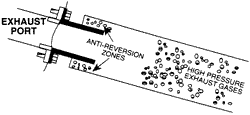
short drag pipes. When we add a device known as a reversion cone (also called
A/R cones or Tork valves) we are fooling the pipe into believing it is
longer. This critter is a cone shaped doodad that is put near the head to
catch the sonic wave and decay it. When the decayed wave returns to the
valve, it will have less amplitude just as if the pipe were longer. Other
ways to effect the sonic pulse includes the shape of the tip of the pipe,
baffles, stepping the diameter of the pipe, expansion chambers and cyclonic
tips. This effects jetting because every pipe has
different dynamic characteristics that change the air flow through the
engine. In some cases, the waves blow the airflow down or dilute the mixture.
In other cases, the wave arriving at the right time helps pull the spent
gases from the combustion chamber. For every different length of pipe, there
is a rpm that this happens at and that is known as the tuned rpm. For a
specific rpm, there is an effective length that is known as the tuned length.
Since this is not a math course, I will not bore you with the formulas, but
if you are interested, call and I will let you know. Now that we have laid out the basics, it's time
for some conclusions. If every pipe was made the same way, we would not need
to change jets. But each is different and the airflow needs are changed,
depending on the tuning characteristics. Drag pipes are effective at the rpm they are
tuned for and hurt performance everywhere else. For stock displacement
engines, bigger diameters are not better. The shorter the pipe, the higher in
the rpm range it is effective. Reversion cones help. The longer pipes are
better for low-end power. Baffles or mufflers help. Different shaped tips
help. Gee, when I was growing up, the chopper I saw
had long, up-swept fishtail pipes. Going back through what we just discussed,
those guys had a pretty good idea of what worked. What I'm explaining is not
new by any stretch of the imagination. These are proven, physical principles
practiced at every drag strip and racetrack around the country. Now that I have gotten on my little soapbox for
a bit, let's examine the state of the aftermarket exhaust industry. The folks
making pipes today are smart. They know what I have outlined here. They make
those big diameter drag pipes because that is what you, the customer, seems
to want. And the Harley® riding public buys them. The bigger the diameter,
the lower and louder the tone of the pipe. The longer the pipe, the deeper
the tone without necessarily being loud. When you pick your pipe, you have to
make the choice between max performance and looking and sounding cool. One of
the reasons I love the way of life we have is that you decide, not someone
else. What I'm trying to do is allow you to make an educated choice. That wraps it up for this issue |