
NEWSLETTER #2 from USA - 2012~ by Dorothy Beebee (IMDI)
The IMDI is happy to anounce that it will be reprinting Miriam C. Rice's book, "Mushrooms for Dyes, Paper, Pigments & Myco-Stix", available in October 2012!
“SOMA CAMP ”, in January 2012 was a Wild Mushroom gathering sponsored by the Mycological Society of Sonoma County, California, that for 3 days brought together mycophiles from all over the USA for collecting, eating, growing, and yes, fiber arts with wild mushrooms.
The SOMA Camp fungal fiber arts program offered beginning, intermediate and advanced mushroom dye workshops led by Dorothy Beebee and Tina Wistrom using fresh and dried fungi collected from the area: Dermocybes for all shades of red, rose and salmon (D. semi-sanguinea, D. phoenicea, D. malicoria, D cinnamomea), dinner plate-sized Gymnopilus spectabilis and Phaeolus schweinitzii rewarded us with light and bright yellows, gold, and greens, while Omphalotus olivascens (“Jack O' Lantern fungus” found growing under oak and madrone here on the West coast) graced us with shades of violet and green on wool and silk. The only mordants we used in our workshops were Potassium alum and Ferrous sulfate, but lots of experimentation with pH changes using distilled vinegar and washing soda increased the wide variety of possible hues. Old faithful Pisolithus tinctorius was also popular for dyeing wool, cotton, silk, mohair, and yes, even Dorothy's own silvery locks in the popular “Dye your Own” workshop where everyone brings their own fibers to dye with and use up all of the left-over mushroom dyes….
Besides mushroom dyes, Marilyn Buss taught Felting of bowls and Needle Felting using mushroom dyed wools, Shibori patterned dyes on silk, and Coiled Basketry taught by Gayle Still, taking special advantage of the wide variety of mushroom pigments to be found in our California coastal, mixed conifer & hardwood forests.
In October 2011, Dorothy Beebee presented a lecture/slide show about “Miriam Rice and the History of Mushroom Dyes” at the TAOS WOOL FESTIVAL, in Taos, New Mexico.
A lecture and demonstration about local California mushroom dyes was also presented by Dorothy Beebee in December 2011 at the Mycological Society of San Francisco "FUNGUS FAIR" . These events all occurred successfully in spite of our unusually dry 2011 Fall and Winter here in California. In fact the first real rains of the 2011 /2012 winter season have NOW finally begun to fall in February and by the end of March 2012 we were up to 50% of normal. Interestingly enough, it was one of the best years we have had for Dermocybe phoenicea collecting under pine along the edge of the Pacific coast in California, but next to nothing appeared in our customarily prolific inland spots for D. cinnamomea and D. malicoria…. The Hydnellum aurantiacum was plentiful for soft blue-green hues, but Sarcodon fusco-indicus was rarely found, if you could spot the dark purple-black toothed wonders tucked away in the Douglas fir duff. Now, we are wondering what new fungi all of this new Spring rain will offer for our dyepots. What a crazy winter weather season!!!
___________________________________________________________
NEWSLETTER #1 - USA -2011
Letter from Susan Hopkins, USA
Adirondack
Dyers 2010, Saranac Lake , NY,
When I retired in Sept. 2009 I moved to Saranac Lake in upstate NY, 2 hours
from
Montreal, Canada. I moved here for the mushrooms, dyers and all kinds too.
My cousin Nancy Parker and I have vacationed in the Adirondacks, off and
on over the last 50 years. I already knew where some of the best dyers grew
and my first full summer or collecting season did not disappoint. This area
is mostly conifers and maples with some beech,aspen and both white and yellow
birch. What I was used to in NJ was mostly deciduous trees of oak, beech,
maple and some hickory and only a smattering of conifers. White pine is a
predominate tree here so I knew Phaeolus schweinitzii should
start appearing in early to mid July if I looked hard enough at the base of the biggest trees.
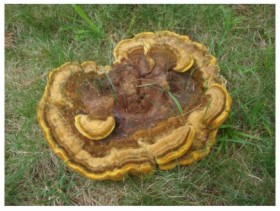
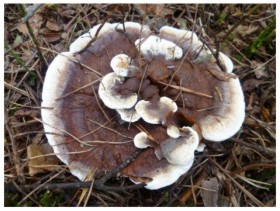
This proved easy even while driving as P. schweinitzii is usually large,
flat and very yellow at the growing edge- the best stage for dyeing.
 |
 |
|---|
It can be dried whole so I ignored several rosettes on my screen porch till they fit into my food dehydrator. I was pleased to continue finding P.schweinitzii till Sept 1st when I left for Sweden and the International Fungi-Fibre Symposium for 2 weeks. I had seen P. schweinitzii under Douglas fir both in Scotland and on the West coast of the USA but here in the Adirondacks it was mostly under White pine, once under spruce and once under Tamarack=Larch.
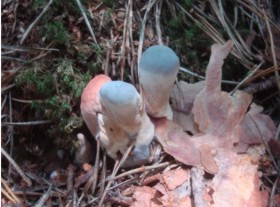
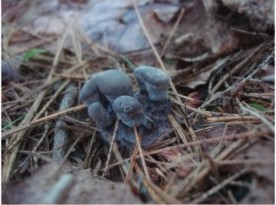
For the first time I could watch my Hydnellums and Phellodons grow right from tiny standing blobs. This group takes its time growing, taking 2-3 months for the same fruiting bodies to mature. Most of them have a spongy or felt like layer as part of their stem which allows them to retain moisture for a long time while the surrounding area drys out.
 |
 |
|---|
This allows them to continue growing longer than any fleshy mushroom. As they are all mycorrhizal they will appear in the same place year after year. Over the years one species would be more predominate each time I came up to look in the same place but all species were represented. After only one full season with good rain all summer in 2010, I think this is due more to when I came to look varied from mid Aug to late Sept. Each species comes out to maximum growth at a slightly different time than the others. I found that Phellodon niger came out and matured first by Sept. 1 while P. alboniger hung on longer. Hydnellum aurantiacum and H. caeruleum and H. ferrugineum=pineticola are very close in time and growth and did well in 2010. H. ferrugineum=pinticola, the poorest dyer, is always the most abundant every year. H caeruleum matured in early Oct after I first spotted the same fruiting bodies in early Aug. With all the tooth fungi I believe the more mature fruiting bodies have more color than the young ones so it is better, but hard, to let them grow big before picking.
Cortinarius semisanguineus is wonderful for reds and oranges. I had one outstanding year both in the Adirondacks and in NJ in fall of 1996 but every time since then I was looking too early. These mushrooms like it cold and wet and now I know they can fruit over a 6 week period in the Adirondacks from mid Sept till the end of Oct. and even into Nov. Another mycorrhizal fungus up here, they grow in the big CCC stands planted in the 1930s of pure Scotch pine, Pinus sylvestris. Kirsti Palmen of Finland taught me many years ago that the red is concentrated in the largest caps, not in the stems and young whole fruiting bodies. I now sort my mushrooms for drying, separating the caps from the stems and young ones. The stems and young fruiting bodies are still worth keeping for a good strong orange. They were very wet but dried easily in my food dehydrator. I even kept the “sploges” or rotting red blobs that I found while collecting although they must be cooked up fairly quickly.
This year I found my first small collection of Cortinarius malicorius. I had seen this species in Scandinavia and in Quebec at big forays but it was exciting to find it on my own near where I live. I know it dyes strong yellow-oranges.
Another late fall
mushroom good for dyeing is any species of Boletopsis for
greens and teals with alum. After a recent paper published by Dr Roy Watling
of Scotland comparing USA collections to European collections I tend to
not put a species name on any Boletopsis. Here in the Adirondacks they
seem to like balsam fir trees as well as cold and wet. Again the more mature
fruiting bodies I think have more pigment. Soaking first, from either dry
or fresh, I find makes a big difference as sometimes the 2nd or 3rd bath
yield more or a stronger color then the first bath. Boletopsis sp. are
white to gray and very similar looking to Boletes but are more closely
related to Hydnellums and Phellodons then
Boletes. That is one of the reasons they dye in the same color range
as the Hydnellums and Phellodons, which is teals and greens. They can hide
in the duff but are also mycorrhizal so will come out in the same place
year after year.
This winter has had a lot of snow where I live but I am very much looking
forward to this summer and the 2011 Fall collecting season.
Fall 2010- 2 mushroom dyeing classes by Susan Hopkins, Saranac Lake, NY
I taught 2 workshops on mushroom dyeing, each having 8 students, in October
2010, one for 1 week in North Carolina and the other for 4 days in Penn.
Being over several days we were able to use a different group of mushroom
species each day and establish some basic procedure for extracting the
pigments. The procedure was well known for natural dyeing.
· Decide on a ratio of dry mushroom to fiber- we used wool in both
classes
· Break up the mushroom into small pieces- place in cheesecloth bag
· Soak the mushroom overnight and in distilled water if possible
· Cook the mushroom for 1 hour at least at a simmer-not a boil
· Cook the mushroom with pre-mordanted wool-mordants used alum and
iron mostly again; no boiling
· Cool down wool before rinsing out and drying – bath is ready to use again
if strong enough.
The North Carolina class mordanted their own wool at home or within the first day while the Penn class had the wool pre-mordanted by the Manning’s studio where the class was held. On the first day each pair of student were able to start with Phaeolus schweinitzii and Inonotus hispidus. Both are easy to get good strong colors from and for me to replace. I like to use these 2 species while students are learning because they can take a lot of abuse and still produce good results. They can be over cooked, under cooked, ignored, too little used or rinsed out to soon and still dye good strong colors. Phaeolus schweinitzii dyes yellows and golds with alum and dark greens with iron. With alum and iron we did get chartreuse in several pots. Inonotus hispidus dyes burnt orange and deep golds with alum and khaki browns and dark browns with iron. With each species the color was also dependant on the age of the fungus when it was picked and dried.
 |
 |
|---|
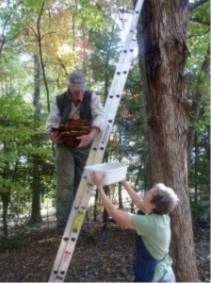
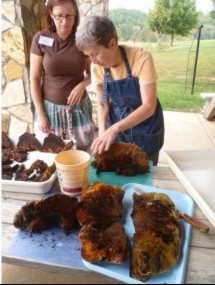
We were lucky in North Carolina that one of my students, Sandra David, found Inonotus hispidus on a huge white oak tree when she first arrived. On the first day of class we all carried plastic bins to the spot where it was growing. The school maintenance man had to use a 20 foot ladder to cut the fruiting bodies off the tree for us. There was 32 lbs. in large pieces just right for dyeing that we cut up into “pork chops” to dry as much as we could before dividing up to take home at the end of the week.