
Many of my paintings are golden rectangles, an ancient mathematical and geometric construct very popular with artists over the centuries. The Pythagoreans used a five-pointed star constructed from diagonals of a pentagon as a symbol of their brotherhood. As a star, these diagonals intersect one another in the golden ratio. Leonardo da Vinci, Albrecht Durer, Georges Seurat, and Paul Signac deliberately based the linear patterns of their paintings on the golden section. The Encyclopedia Britannica states that, Golden mean proportions can be discovered in the design of many other styles of painting, although they may have been created more by intuitive judgment than by calculated measurement. With such a profound historical foothold, it would seem foolish to ignore the potential subliminal value of this shape.
Here is how one constructs a golden rectangle by geometry. The actual dimensions do not matter. Draw a square A-B-C-D and then find the middle point M of the base line A-B. Draw a line from M to C. Using M as a radius center point, rotate the C-end of line M-C down to the horizontal base line A-B where point C now becomes the extended point E. Draw a vertical up from point E until it intersects the extension of line D-C and label that intersection as point F. The newly formed rectangle A-E-F-D is a golden rectangle.
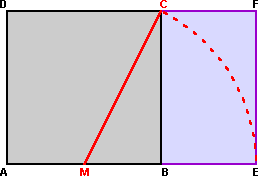
But what makes it golden? Why is this shape regarded as magical? Well, inside the big rectangle is the smaller rectangle B-E-F-C, right next to our original square. This smaller rectangle is also a golden rectangle; that is, it can be divided into a square with sides equal to its short side, and yet another even smaller golden rectangle, and so on and so on ad infinitum.
Feel free to apply some numbers to the lines of the above geometry. You will then discover the following math magic: Line A-E divided by line A-B produces the same answer as line A-B divided by line B-E. And that's just the bottom line! Above it you will find that line A-E divided by line E-F produces the same answer as line E-F divided by line B-E. To put all this algebraically:
Of course, the golden rectangle is descended from the golden mean, aka the golden ratio, aka the golden section, aka the golden proportion. This has to do with dividing a line into two sections which each have a mathematical relationship to one another and to the whole undivided line as well. That the intersecting diagonals of a perfectly pentagonal star cross at the golden mean division point of each diagonal line is fantastic enough when you think about it. Actually expressing it algebraically and mathematically is simpler than you might expect. This is how one divides a line to create the golden section:
Draw a line A-B and label the length of this line x.

Now divide line A-B at interior point P in both extreme and mean ratio; that is, so that AB/AP = AP/PB; or to put the formula another way:

Numbers can be applied here as well. Without extrapolating to infinity let us assume x (the length of line A-B) = 1. Then y (the length of section A-P) must be 0.61803399 and x-y (the length of section P-B) must be 0.38196601. Of course, I've rounded off the calculation to 8 decimal places, but who can divide a line 6½ inches long into hundred millionths?

The golden rectangle is a rectangle R with the property that it can be divided into a square and a subsidiary rectangle whose dimensions produce a ratio identical to that of R. Multiply through these last equations by y and by x-y:

In his 1202 AD Liber Abbaci (Book of the Abacus) Leonardo de Pisa Fibonacci records an arithmetic progression in mating rabbit pairs. Similar sequences are found in the expanding spirals of pine cone spikes, sunflower seeds, and the chambers of nautilus sea shells. The golden ratio is related to the Fibonacci sequence. If in nature by chance, why not in art by design?