Dreamweaver 2 Bible"A Complete Reference" |
||
Click on a thumbnail to enlarge it. Use your browser's "BACK" button to return to this review when done. |
||
 Title:
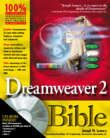
Dreamweaver 2 Bible Title:
Dreamweaver 2 BibleAuthor: Joseph W. Lowery http://www.idest.com/dreamweaver Publisher: IDG Books, Inc. http://www.idgbooks.com Publication Date: May 1999 Pages: 1034 with CD ISBN: 0-7645-3322-3 Price: $39.99 |
||
 |
||
| Dreamweaver 2 Bible by Joseph W. Lowery, is a comprehensive guide to Macromedia Dreamweaver 2, a Web site development and management tool. It is written for both Mac and Windows users, and the book can be used as an introductory aid for beginners and a useful reference tool for more experienced users. You get full coverage of the new features in Dreamweaver 2, plus detailed instruction and examples for such features as: implementing CGI scripts, JavaScripts, applets and controls on your Web pages, working with frames and Cascading Style Sheets, using Dynamic HTML, XML and SMIL. There is an accompanying CD-ROM that includes shareware, demos, and nearly 300 Dreamweaver extensions, including behaviors, objects, commands, style sheets, browser profiles, inspectors, and queries. You also get a Web resource directory and all the sample code from the book. IDG Books has other books in the Bible series. See their Web site for more information: http://www.idgbooks.com | ||
 |
||
| Beginning, Intermediate and Advanced computer users. The book is written for all Web designers from the individual who is just starting up and needs basic information on HTML to the professional who needs advanced tips and tricks. It is a complete reference for everyone working with Dreamweaver on a daily basis. | ||
 |
||
|
Dreamweaver 2 Bible can be read from cover-to-cover or you can peruse
each section as needed. The book is divided into nine major task-oriented
parts. The early chapters present you with the basics, and the chapters
have clearly written steps for the tasks you need to perform. In later
chapters, you will find sections that provide you with step-by-step
instructions for accomplishing specific Web designer tasks; for example,
building an image map that uses rollovers, or eliminating underlines
from hyperlinks through Cascading Style Sheets. The book is very well
organized, and even though it is not in color, it has a wealth of illustrations
and tables on almost every other page. Each chapter begins with an overview
of its information, and ends with a quick summary. There are various
icons placed in the text to indicate important or especially helpful
items: Tips--provide you with extra knowledge that separates the novice
from the pro; Notes--provide additional or critical information and
technical data on the current topic; New Features--sections marked with
this icon detail an innovation introduced in Dreamweaver 2; Cross-Reference--indicate
places where you can find more information on a particular topic; Caution--provides
you with a warning of a potential problem or pitfall; and On the CD-ROM--indicates
that the CD-ROM contains a related file in the given folder. Part IV:
Extending HTML Through Dreamweaver--Chapters 15 through 19
introduces you to the world of CGI programs, external plug-ins, Java
applets, ActiveX controls, and scripting with JavaScript and VBScript.
You will find techniques for ensuring a secure middle ground of cross-browser
compatibility in the ongoing browser wars. You are shown how to use
built-in objects for Web page layout. There is an in-depth look at the
capabilities of Dreamweaver behaviors. Each standard behavior is covered
in detail with step-by-step instructions. Coverage is given to Dreamweaver
extensibility, with complete coverage of using and building commands
as well as custom tags, translators, and C-level Extensions. Part VIII: Connectivity Through Dreamweaver--Chapters 29 through 30 looks at e-commerce and how Dreamweaver can help you design your site for this electronic commerce. Database basics are explained. Part IX: Web Site Management Under Dreamweaver--Chapters 31 through 34 will show you how Dreamweaver makes site management easy. The program's built-in tools for maintaining cross- and backward-browser compatibility are explained. There is a demonstration of how to browser-check a Web page that automatically directs users to appropriate links. Dreamweaver's Library is looked at, as well as the Site Window. Templates and how they can speed up production while ensuring a unified look and feel across your Web site is discussed. Appendixes--Appendix A describes the contents of the CD-ROM that accompanies the book; Appendixes B and C have an abbreviated user's manual for BBEdit for the Macintosh and HomeSite for Windows, two HTML editors; Appendix D dives into a look at Dreamweaver 2 Attain. |
||
 |
||
| The Dreamweaver 2 Bible is the most comprehensive book I have found on Dreamweaver. Not only does it cover Dreamweaver, it also includes information on HTML and DHTML. It has a good balance and is neither too simple nor too complex. Considering the breath of the material, the language is easy to understand, and the tables and illustrations are indispensable for a reference book. This is a must for anyone serious about learning Dreamweaver 2. | ||
|
Graphics: Adobe
Illustrator & Adobe Photoshop |
||
|
|
||

