|
|

Last month Ron Lyons shared a tremendous amount of information on dragonflies and damselflies with us. If you missed his article please click here: DRAGONFLY ARTICLE. Now that we are aware of their life cycles and behaviors, how can we apply that knowledge to protect these critters in our ponds?
Well, I've been learning by experience. My first experience was a very 'bad' one: The Creeping Primrose was growing by leaps and bounds and needed pruning last Spring. So I walked right in, used the pruning shears to lop big sections off and hauled them immediately to the compost/shredder-grinder pile in the back of our lot. Hours later I walked by the pruning pile again and was horrified to see literally dozens of damselfly nymphs dramatically trying to metamorphose on the spot as their only chance of survival (gills don't work well in the air!). Many were not successful as they weren't really mature enough to be ready and had deformed wings, etc. I felt horrible. Since then, whenever I prune back any under the water or floating on the surface plants, I place the pruning alongside the pond edge so that any hidden critters can drop back into the pond. I usually leave them there overnight before taking the pruning to the compost pile, but even doing that for just a few hours would undoubtedly save many larval forms that live in our ponds. Care should also be taken when repotting water plants.
When Fall arrived I was kept busy netting leaves out of the pond. At least I had learned! I began checking the leaves and sure enough, there often was a damsel or dragonfly nymph on them. So I developed the technique where I pile the leaves loosely into a 1 or 5 gallon bucket as I collect them. The water that adheres to the leaves pours down and collects at the bottom of the bucket. Most of the "captured" larva wiggle about in distress and end up eventually in the water at the bottom of the bucket. Then the next day I lift off the leaves to compost them and check in the water that has collected in the bottom to see what's there. (Sort of a treasure hunt!) I "save" any damsel/draonfly naiads by picking them up and putting them back into the pond. They don't bite! But the squeamish could attempt netting them out I suppose. I admit to not saving the snails and little red worm-like critters I find. But I have also found mayfly larva, water beetles, backswimmers, water striders and other insects which I try to identify.
Now this last month I've been using a bottle brush on a pole to pull out gallons of stringy algae (fun, fun, fun!). And guess what I do? YEP, I put it in a bucket overnight. Most of the dragonfly/damselfly larvae seem to appear at the top and sides of my bucket of green goo. So, I pick them up and put them back into the pond. One other "protection" to be aware of is if you need to treat your fish for disease. Be aware that any medications that say they may be harmful to invertebrates will likely harm your dragonfly/damselfly nymphs too. If possible always treat sick fish in a separate hospital tank/pond.
If any of you have any other suggestions I'd sure love to hear them. Kathy Biggs
Visit Kathy's new California Damselflies and Dragonflies site which has links to pictures of over 31 species.
Please consider your pond a haven for wildlife and a treasure in these
days of diminishing natural wetlands.
In conjunction with Alan Farmers' "Critters in the Yard" information on birds, I, Kathy, would like to tell you about phoebes, probably the most likely bird you'll find feeding at your pond.
Phoebes are insect eating songbirds, members of the flycatcher family.
You've probably seen them perched on the rocks and foliage near your pond, making
little darts over to your pond's surface and then flying back to just about the same
perch. In the West, including Arizona and Texas, we have Black Phoebes. Eastern Phoebes
live on the other side of the Rockies and occur only in the eastern 2/3 if the USA
and parts of Canada. A third Phoebe, the Say's, also is found in the West but is much
less likely to frequent your pond. I'm most familiar, as a Californian, with the Black
Phoebe, but most of this information applies to the Eastern species also. The Black Phoebe
has a black head, back, wings and tail with a white "belly". Easterns are less
dramatically "dressed" and wear drabber shades of grays and white. Their postures and mannerisms
are much the same. All three species engage in "tail-wagging", a behavior that
somehow seems charming and almost like a hello wave to us humans.
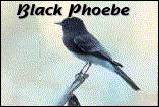
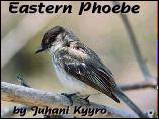
Both Black and Eastern Phoebes have a cheerful "fee-bee" call that they give ~20 - 40 times a minute. Common and easily observed, their fondness for our ponds is because they like to catch insects 'on the wing' as they rise from the water's surface or are caught on the surface (Yes, this would include damselflies as they emerge). Typically a Phoebe will visit the pond for 5-10 minutes for several brief sallies for prey into the air above the pond or to glean from the surface. Their diet is almost exclusively insects, but I wouldn't put it past them to snatch up a mosquito fish fry or two. Their nest is made of mud pellets and plant fibers and lined with grass, hair, and rootlets. They will nest under your eaves in a protected, quiet area if you provide a ledge for them to build upon. Otherwise they prefer to nest under bridges and in old barns.
One of my favorite remembrances of Black Phoebes is when ours fledged 5 young and papa perched them all in a row on a branch of our oak tree while he sallied back and forth, catching mosquitoes and gnats to feed them, each in turn. At the time I was raising one orphaned Phoebe who appeared to be the same age. He had really endeared himself to me by opening his black beak and, I swear, saying "Feed me, feed me!" But I realized the opportunity this papa Phoebe was providing me: I released my orphan and he immediately joined the other 5 fledglings on the oak branch. Luckily papa couldn't count that high and he fed him and trained him thereafter as if he was one of his own!
I hope you get to see a Phoebe at your pond soon. They are year-long residents. You can encourage them by placing a nesting shelf under your eaves and then providing them privacy if they do nest. Best of luck. I'd love to hear about your Phoebes: Kathy Biggs
To see Kathy's Phoebe in action visit her
Wildlife Pond Sighting Site.
Next month "Critters" will include a feature about BATS. If you have some
favorite bat links, please send them to us!
| Inviting Birds into Your Yard: Alan Farmer | Table of Contents |