~ November 2002 ~
Here's
to a great harvest!
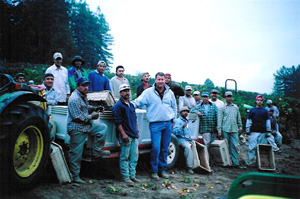
We had a great 2002 harvest, with dry,
sunny weather, low crops and wonderful quality. Steve and his crew did
an awesome job as always. Dan commented to Steve that he seemed to be
completely in his element here: in a vineyard, with his crew and his tractor.
To which Steve replied, "Don't forget the walkie-talkie!"
We know it's a busy time for everyone, and we appreciate all your hard work throughout the year. We wish you and your families the happiest of Thanksgivings!
After draining and pressing, the wine headed to barrel for malolactic fermentation. Though the wine eventually saw 70% new wood, we used a lower percentage of new oak in this first stage of the wine's life in order to best assess the eventual wood needs. We use five different French coopers (for example, we like the roasted nut character we get from Seguin Moreau Chassagne Montrachet, the high-toned ginger characters that come from Remond Troncais, and the beautiful, slightly gamey character from the Francois Freres Bertranges) to improve the complexity of the wines and avoid overoaking with one particular flavor. The barrels were stirred periodically to soften the wine and stimulate ML. Due to the early harvest, 2000 was a very good year for malolactic fermentation, so the first sulfuring of the individual lots was completed by January, 2001. From that point until the blend was made, the cellar was kept as cold as possible in order to hasten settling for clarification. Extra new wood was added to the densely structured Green Valley and Jewell lots.
In early March, after an extensive series of lot and blend tastings, the wine was racked to assemble the blend. During the short period it was in tank, the barrel characters were again reassessed, and the final blend put back into 70% new wood. We like to add new barrels that have had Chardonnay fermented in them, which softens the harsher wood tannins and smoky characteristics and brings out more of the caramel flavors of the wood.
The wine rested in barrel from March until bottling, being pretty much left alone to meld, except for monthly topping and SO2 checks. Careful microbiological assessments were also done in order to safely bottle the wine unfined and unfiltered. The first of August, we carefully racked the wine out, then bottled it on August 8, 2001. After bottling, we allowed the wine to rest again until releasing it to you in May of 2002.
~~~~~~~~~
2000
Morelli Lane Zinfandel is completely allocated
We hope that everyone who wanted some of this wine already
took their allocation, because it is no longer available. The 2001 Zinfandel
should be released in the early part of 2003, so stay tuned for more details
soon.
2000
Dutton Ranch Pinot Noir: The Story
As you
probably know, of all our wines, the Dutton Ranch Pinot Noir is the one
we produce the most of. It's been getting some great press lately (including
the Wall Street Journal and San Francisco Chronicle top
picks we've told you about recently, as well as a 90 in the November
2002 Connoisseur's Guide to California Wine). To go along with
what's happening now with the wine, we thought we'd share its
history from vineyard to bottle with you, giving you the complete picture.
Dan and Steve start by selecting their favorite vineyards that will go into the blend. For the 2000 vintage, they chose four vineyards, all from the Russian River Valley-Green Valley sub-appellation, but each of which imparts a different flavor or quality to the wine, according to their location in the valley: Green Valley Vineyard gives bright raspberry flavors, Jewell Vineyard contributes spice and tannin backbone, Widdoes Vineyard adds deeper blueberry notes and great acid structure, and Morelli Lane Vineyard imparts rich, plumy depth.
The vineyards were picked over the course of about a month during the harvest of 2000. The first vineyard picked, due to its relatively warm location on top of a hill, was Morelli Lane in the first week of September; next was Jewell Vineyard on September 15; Widdoes, which is on the same ridge as Jewell, followed right behind on the 17th; and finally Green Valley, at the cool bottom of the valley, was picked at the end of September. As each vineyard was brought in, it was destemmed (except for some clusters left whole from the clone 777 portion of Green Valley), then cold-soaked for 5 to 7 days. We keep as much of the fruit whole as we can so that we get more characteristics from the skins rather than the seeds.
After cold-soaking, the fruit was fermented using indigenous fermentation for some lots and various inoculated yeasts for others. We like to have the indigenous yeast get things started, then inoculate with a yeast that suits each particular lot (for example, Assmanshausen, with its moderate fermentation rate, does a great job bringing out the bright raspberry characteristics of the Green Valley Vineyard). The yeast take anywhere from 5 days to 2 weeks to utilize all the sugar in the must; once it goes dry, we think about draining the finished wine off the skins, and, depending on the tannin structure of that lot, it was drained right at dryness or up to two weeks after. Once the tank was drained, the skins and seeds were pressed in an old-fashioned basket press, which, because it macerates the grapes the least, we feel gives the highest quality press wine. About 70% of the press wine, with its beautiful aromatic components, was added back in, making up about 15% of the final wine blend.
and/or reply to us with the name and email address to be added to our distribution.