|
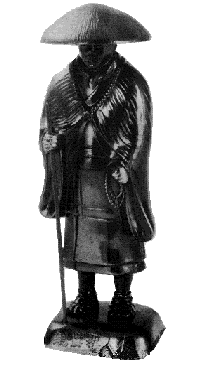
Shinran Shonin (1173-1263) was a Japanese Buddhist priest, who lived during the Kamakura period. He is recognized as the founder of Jodo Shinshu (True Pure Land) Buddhism.
Shinran's struggle for enlightenment spanned twenty years of traditional
Buddhist practices in the monastery temple community known as Mt. Hiei,
near the city of Kyoto. In spite of all his faithful efforts, he failed
to attain the spiritual awakening which he so deperately sought. The years
he spent on Mt. Hiei had served only to make him more painfully aware of
his own spiritual weakness and human limitations. His life was finite, his
knowledge was incomplete, and his capacity for absolute goodness was imperfect.
After twenty years of struggle he was forced to concede that enlightenment
was impossible for the common person to achieve. All seemed hopeless.
In this state of despair Shinran determined that he must search for another way. He left the monastery. Shortly thereafter he met a Buddhst master named Honen Shonin (1133-1212), who taught a simple faith in the Amida Buddha, the Buddha of Infinite Life and Infinite Light. Taking refuge in and reciting that Buddha's name (Namo Amida Buddha) was taught by Honen to be in accord with the Buddha's original Vows and most fitting for those of the Latter Dharma Age, unable to find a suitable master or practice to follow.
For the first time Shinran experienced a deep inner peace. It came in the realization that the practice of taking refuge in the Amida Buddha (Namo Amida Buddha) was suitable for such a man as himself since it expressed both the truth of his false self and the Buddha's concern for those ordinary people who are plagued by the Three Poisons of Greed, Anger, and Ignorance. |