Chapter Four: 1991
A championship team is built in
three stages, like a pyramid. At its base are each player's individual skills.
In the middle is learning how to play together as a team. And at the apex is
something called competitive greatness.
– John Wooden
January 1991 was the coldest month on record in Sacramento. The temperature never got above freezing. Entire eucalyptus groves died. Kids made ice slides by watering their driveways.
Robin got very sick. She was in bed for a week. By the time she recovered, we knew we couldn't stay in Sacramento any longer. So we decided once more to return to San Francisco.
As luck would have it, we returned to the heart of the City, the Castro district. Indeed, to understand the heart of The Beat, we must explore what it meant to live in the Castro in 1991.
It's been said that there are only three storybook cities in America: New York, New Orleans, and San Francisco. Over the years there have been many neighborhoods that made up the fabric of the City by the Bay: Chinatown, the Mission District, North Beach, even Haight-Ashbury. But the Castro represented the most recent, vibrant, spiritual and intellectual heartbeat of the City. One could get a sense of that beat by visiting four bars in the area.
The first of these was The Brig, which was actually on Folsom Street south of Market. As it was not in the Castro, so too it was not typical of the Castro, though it did represent a select aspect of the gay lifestyle -- total leather. I went there with a friend looking for her brother. A burly man at the door said, rather politely, "I don't think they want you in there." Inside was loud music and as much black leather as could be crammed in. A person could feel just a little out of place dressed in anything else. Yet, though this might be the national stereotype of the Castro, it was not the aspect of the Castro that made The Beat.
The second bar, Rockin' Robin's, was a little bit closer both geographically and spiritually. It was a dance club, with a long horseshoe bar, a dance floor at the far and, and places along the sides to socialize. There was a long high bench along each wall, along which you could see every combination of human being: male and male, male and female, female and female, various sizes, shapes, colors, and ages. And each couple had that same look, staring into each other's eyes as they shared a moment of growing closer, enjoying an evening of being alive with each other.
The third was The Metro, at the corner of Castro and Market, overlooking the busy intersection from the second floor. It was hip and spiffy, with chrome railings and comfortable seating. Pool tables and a patio allowed folks to drift around, enjoying their conversations. I was sitting there one evening when a former teammate came in and greeted another with a brief kiss on the lips. It differed from the standard American custom in a way that Middle Eastern greetings do, but with a greater affection. And it made me wonder: could men who shared a physical attraction actually have a greater sense of camaraderie?
The fourth bar was the Elephant Walk, a block away at 17th and Castro, the center of the heart of the City. It was a fern bar, smaller than the Metro, and quieter, with plants hanging above booths near the windows and a small dance floor between them and the bar. At the Elephant Walk you could walk in with a new friend and fall in love. As you danced on the dance floor, learning how each other moved, enjoying the thrill of each other's touch, dozens of eyes would be watching you. It would not matter which one of you they found attractive; indeed, there was no crassness in such an exhibition. So long as it was a love that grew from affection and respect, then all could bask in the shining nova.
This, then, was the simple lesson. Love is all you need. And so too with The Beat. If a person came to the team with that attitude, we would all flourish. Without it, we would fail, no matter how skilled and efficient.
Does that mean everybody was kissing? No, though Willie Doyle's wife, Wendy, said that we sure did like to hug a lot. Every team in every sport seems to find some comfortable way of touching. From a simple high five to a Tommy Lasorda hug, the manner and amount seem to vary with both the individuals involved and the intensity of the experience. And it did not seem to matter that some of the members of the team were gay.
Consider, for example, the ass-slap. The ass-slap is saved for big events, like a home run or a great defensive play that ends the inning. No one walks up to their teammate and slaps their ass just to say hello. It seems as though the bonds of camaraderie reserve the closest moments for the greatest moments.
It is even more sophisticated, since some people are neither ass-slappers nor ass-slappees. Yet somehow teammates realize this, and avoid offending behavior. On a team that included gay ballplayers, perhaps more than we knew, no one ever felt uncomfortable. The respect we had for each other grew to be far stronger than any of our differences.
There was one ritual, though, that seemed unique to The Beat - the reading of the lineup. We would gather around the circle while Jim announced each batter, who would go around the small circle high-fiving every other player. We would then put our hands in the center together and on a count of three yell "Beat." I'm not sure when it started; I do remember Mike Laffey telling us to give the "Yo Bundy" on three. It was more a basketball thing than baseball. None of the other teams did it, and at first it felt a little silly. But it did seem to make us more of a team, and as the years went on I realized that there was an unbroken link that connected everyone who had ever put their hand in that circle as a member of The Beat.
The members of The Beat that season were the best of its first and second generations, with a couple newcomers. One of those was Robert Bingham. Robert was a barrel-chested man with great upper body strength, all wrapped in the same southern charm that Wilfred and Ann brought to the game. He and his lovely wife Misha were, how shall we say, bawdy. During one game, with The Beat winning nine to six, he started out to the field after our at-bat and yelled with a grin to Misha, "What's the score!" With blond hair waving in the breeze and a wicked smile, she yelled out proudly "Six-t'-nine!"
Robert joined us in the spring, along with Doug "Brett" Butler. Doug was a ringer, an exception to The Beat tradition. Jim had decided to "draft" someone from names at the league office to try to give us more power. Doug and his ringer predecessor, Scott McKee, had the oddest handshakes. Scott's especially felt like a limp noodle. They never really caught on with the group, but each contributed three seasons to the team's progress.
The returning players included myself, Jim, John Palmer, Eric Meyer, Mark St. George, and Peter Wenner from the first generation; Dan Carroll, Frank Green, Mike Laffey, Wilfred Spoon, and Jeff Ricketts from the second generation. Wilfred was actually on the DL with an injured knee, which led Jim to make his most important decision since founding the team.
Jim had always relied on his coaching staff to set the lineup. Each week he, Kevin, and I would sit down and talk it out. With Kevin gone and Wilfred chomping at the bit, Jim decided to make him a coach. I remember the first time we went to his place, and sat down at the table to work on the lineup. A few minutes into the conversation I looked up and saw Ann, hovering, fidgeting, with that certain fire in her eye usually reserved for players. I asked her if she wanted to join us, and suddenly everything got a little easier.
Though she was definitely dressed in gray and black, the Woman in White had returned to The Beat.
And just in time. Though dealing with many losses, The Beat in 1991 was marshalling all of its spiritual forces. The fans rallied around the team, led by D'Arcy McGaffic, our resident Amazon. One Saturday in particular stands out. She went rushing around early in the morning to the player's houses, alerting them that the field for the game had been changed. An hour later she was running around again, letting us know the first change was wrong. All with a smile. She knew everything the team had been through, and was always there with her clarion call to cheer us on, especially in the darkest times.
Then there was the music. The Grateful Dead was being challenged by Led Zeppelin as the teams most popular group. But the song of the year for this pitcher was The Door's "L.A. Woman". Peter Wenner, who played first base, would always hand me the ball after the last throw around between innings, often saying, "O.K., O.B., get that Mojo workin'." Turns out the increasing tempo of "Mr. Mojo risin’" in "L.A. Woman" perfectly matches the rhythm of pitching in a close game. Hey, the Egyptians used music to build the pyramids. The Celts used it to build Stonehenge. Could the music of The Beat play any less a roll?
And of course there was Jim. Jim and I, or Gemini, seemed to have a twin-like understanding of the nature of sport. When playing two-on-two volleyball, we had instinctively moved to cover for each other, set each other up. We once played Kevin and Todd Sattler to a hard fought draw in touch football, matching their speed and strength with our timing and intuition. It was tough for Jim to manage himself; you never want to play yourself more than you should, but sometimes he played himself less than he should. I went to him early in the year and said, "Jim, I know you always want the best athletes on the field at crunch time, but this year, you and I should not be sitting on the bench when it gets to that." It was the intangible we were looking for, the competitive greatness, whose very existence eluded so many.
Professional baseball went on strike that year. A week into it one of the local TV stations did a story from Moscone Field about softball. There were some games going on in the background, though no one was in uniform. At the end of the piece, the reporter said, "And so, since they can't get the real thing, these folks just have to settle for coming down here."
I damn near jumped through the screen. "You idiot!" I screamed. "You have no idea what you're talking about!" Elvis would have shot the TV. For The Beat, you see, was about to leave its blood, sweat, and tears on the playing field, and our lives, our real lives, would be changed forever.
"The Beat had a mediocre spring."
[Cue narrator.]
Why is that? Why has The Beat always performed more poorly in the spring than in the summer?
Perhaps some of it has to do with all the Easterners on the team. Frank Green and I, from St. Louis and Pittsburgh, actually yearned for the hotter days, when the blood runs thin and the sweat flows freely. In the summer, baseball becomes a heat-driven hypnotic trance, far more than a casual spring fling.
Perhaps it was the chemistry. Each winter The Beat lost a few players and added a few. As we learned how to play with each other, support each other, develop camaraderie, we were bound to make mistakes, and play was sloppier. We would usually finish each spring with a run of victories, and look to the summer with great expectations.
And then there was the curse of the big ending, the Achilles heal of The Beat psyche. For a team that relied on emotions more than others, a big inning by our opponents would send us into a downward spiral. We would be in the field seemingly forever. Our heads would drop. We would lose our focus and our hustle. And none of us, individually or collectively, seemed to have the will or the power to stop it.
Jim devoted himself to try to find the intangibles that would put us over the top. He kept statistics on every player for every game, trying to find who was hot, and why. Wilfred was the perfect foil. For starters, he was the perfect drinking buddy. While some became obnoxious or just plain dumb when they drank, Wilfred used the social lubricant to explore the many and diverse personalities on the team. It is hard to imagine anyone on the disabled list in any sport contributing more.
Yet even though the spring was usually a throwaway season, at least one person was changed forever. With Tim gone and me still mostly in Sacramento, Jeff Ricketts, Mr. Baseball, stepped up to take on the task of pitching. He struggled his first game, and Jim asked me to talk to him. I wrote him a letter called "Why pitchers talk to themselves": "If you’re ever struggling, your teammates will yell out 'Just get the ball over the plate.' Then, when the other team starts hitting, they will yell out 'Hey, get some arc on the ball!'" The next game he pitched great. It was the third game where he met his destiny.
I wasn't there, but the descriptions were horrible. It was a close game, with The Beat leading in the late innings. The other team was rallying. Their oldest player, a graybeard pitcher, was at second base. The batter got a hit, the ball was fielded cleanly, but the throw was off line.
As Frank Green remembers:
"It happened at Jackson.
I can't recall if there were two outs, or not, but I think that the game was close. It was the last inning, I believe. There was a runner on second. The ball was hit to left. The guy on second may have been the tying run. Well the throw was coming in from the field. I was set to receive the throw. After all of those cutoff drills we practiced, this one was going to work.
The guy was not a speed demon, but it would have been a bang-bang play. All of a sudden, Jeff, who was pitching that day, sprinted down to the third base line, about three feet in front of me. The guy slid early. His leg and ankle got caught in the trench that never seemed to be filled at any time. The only time I saw that side of the batter's box filled was the first day of the season -- before the first batter of the season.
The rest, they say, is history. Being the first one there, I looked down and I saw that he had a nasty little fracture and a dislocation, the way his ankle just flopped there. It may have been a compound fracture. I grabbed a bat and attempted to create a splint for him (those Boy Scout first aid lessons sure did pay off). Fortunately his wife, who was there, was a nurse. We took good care of him until the medics arrived.
By the way -- Jeff tagged him out."
I have stopped watching replays of injuries ever since I saw Joe Theisman's leg broken and bend where it shouldn't. In all my years of pitching, I have never been involved in an injury where an ambulance had to be called, a bone set, and a player taken away. None of us should have to experience that, especially someone so devoted to the game. In the history of The Beat, every player has experienced joy and disappointment, excitement and fear, yet the game never pushed any of us too far. Except for one.
Jeff Ricketts would never throw another pitch.
Most of the summer season has faded from memory, perhaps because its ending was so intense. Fortunately, Peter Wenner was there to remember it all, which is very fitting. 1990 had been a great struggle for the Beat’s first baseman, earning him Dennis Harvey’s penultimate prediction: "The Beat will never win a championship with Peter Wenner at first base." Though he had not heard those words, Pete had obviously dedicated himself to improving in 1991. As each game went by and we remained undefeated, he once came in from the field and said, "It’s really nerve-wracking out there. I feel like if I mess up one play it’ll cost us the championship." Such is the nature of a short season, especially when you play each team only once.
As Pete recalls:
"Jim was right about how the spring season was a good segue. There was a lot of anger in that final game we lost to the Cobras at Lang #1. I recall Jim and Eric throwing things on the bench and guys yelling at each other as our defense fell apart. Frankly, I think Robert Bingham was the missing link as he arrived that summer. His BA was only .310, but his hits were very meaningful including 2 homers. As you said, Robert added a lot of feel-good chemistry which may have helped heal the wounds of the spring. Danny Carroll sure had a big year in 1991 and was a key player that season. And of course, there was Doug Butler. Like him or not, he contributed a lot that year.
"Three of the first 4 games were come from behind thrillers. Holden Chinn looked like a powerhouse when they went ahead of us early. That game was a stunner because they kicked our asses in the spring and were leading by 5 halfway through game 2.
"I recall the Hammertime tie as Jim described it in his article, one of our greatest games. For one thing, we were missing some key players like MSG, Butler and I think Eric. That's a big chunk of our lineup and "Larry Avery" that day was a butcher at 2nd who made several key errors to put them ahead. I recall that Hammertime was up 11-7 late and threatening for more when one of their sluggers hit a ball into the left center field gap at Parkside. Palmer made what I think was the best catch I ever saw by a Beat player (or any player) when he miraculously dove flat out much like Ron Swoboda did on Brooks Robinson's gapper in the 1969 World Series. John held onto the ball and changed the game's momentum because we came back and scored 4 runs with 2 outs to tie it. The ball that Laffey hit off the 1st baseman just dribbled away after the 1st sacker dove and crawled on his hands and knees for it as Harvey and Bingham alertly scored. That tie, in retrospect, saved the season because a loss would've given the division to the Fringe Players.
"The Hammertime game also started a really nail-biting stretch of 4 games that resulted in 2 ties and 2 one-run victories. As you can see from the scores -- 7-6, 6-5, 5-5 -- you really pitched your ass off. Our defense was just fabulous during that stretch and of course the guy that stood out in my mind was Palmer (his brass beat season) with several diving catches and the famous "fire-in-the-eyes" throw from the rover position to get the leadoff batter in the Gamecocks contest who leaned too far rounding first. I can still see John looking my way before he threw that laser beam into my glove. We just barely nipped the guy who dove face first into my glove with the tag. Then they folded like a house of cards after having had the comeback momentum up to that point.
"The Harvey Ballbangers game was the one that Darcy and Co. called everybody to inform them about the change of fields and that too was a thriller, memorable to me because I had a 2-RBI hit that broke the game open to 7-4. I can still see that hit going right up the middle at Jackson #1 with runners on 2nd and 3rd. They chipped out 2 runs in the final frame but it wasn't enough as the game ended 7-6. Check out the Rubbles game write up, too because I also remember what a thriller that was. I can still picture that little fireplug of a slugger who looked like Barney Rubble clobbering a 3-run blast over the tall fence in right at Lang #2. Good move to walk him late in the game…"
…It was the first time Jim had asked me to walk a batter. It loaded the bases in the bottom of the seventh in a one-run game. So often, even in the majors, the strategy backfires. A third tie would have dropped us behind the Fringe Players, who had lost to us but none others. It was a moment when players know that, if they falter, all will be lost, but if they succeed, another demon will be vanquished forever.
A soft fly ball by the #5 hitter ended the game. We were pumped. We had actually used real baseball strategy in a pennant race and made it work. We could hardly wait to play our last game and force a playoff. But as the season drew to a close I kept feeling a tug at my psyche, of something not complete. It seemed that the game itself had one more thread of karma, one that would stretch between Heaven and Earth, that would begin with a simple act of kindness.
"Jim, I think we should get Kevin into the last game. . . ."
They say that in the moment before you die, your whole life flashes in front of you. The moment while Jim looked at me covered about ten years.
Six months of phone calls before he ever met "that wild woman from Sacramento", who "gave good phone." Sherilyn, the ultimate fag-hag, who could dish, dish, dish with the best of them. Dynasty nights. Bar nights. Volleyball, softball, marriage and separation, roommates, confidantes. They were always there for each other.
The ancient Greeks had two words for love, eros and agape (ah-gah-pay). Jim and Sherilyn were in agape.
And then there's that thing when couples aren't a couple any more, be it by divorce, separation, or death. How often friends seem to divide into two groups, how easy it is to lose touch, or even think of one or the other as the cause of all the turmoil. And when one of them is gone forever, how hard to find the answers.
And now, to be confronted with all this, to be asked to re-enter a world with still too many rough edges, too many broken memories, without that very friend who would have understood, who could have helped. And so soon, at a time when he needed all his resources, and certainly no distractions. It was just too much to ask.
Against all of this stood but one thing.
The game.
The moment passed. Jim lowered his eyes, nodded his head.
"If we get a big lead, I'll get him an at-bat."
We did, and he did. I have rarely seen such a look on a batter approaching the plate, nearly drained of all emotion, yet stoic and determined. I forget how Kevin did, but his appearance was what mattered. The Beat nation and all of its players were now ready to play for the championship.
The gods of baseball, October 5, 1991:
Jim Harvey, manager: Jim was actually one of the Titan's, who preceded the gods and created the world in Greek mythology. As time began on opening day, so too did Jim become Chronos, the father of time. Chronos is usually depicted with a leathery face.
(Sherilyn McClure Austin, founder: The Woman in Red; Aphrodite.)
(Kevin Austin, founder: Spock. (Two words: stats, ears.))
And the starting lineup:
1. John Palmer, rover: Hercules. Period.
2. Mark St. George, second base: Mars, via New York.
3. Robert Bingham, leftfield: Ursa Major, LXIX.
4. Doug "Brett Butler" Butler, centerfield: The Tin Man.
5. Eric Meyer, shortstop: The Eternal Rookie. (Flash Gordon?)
6. Dan Carroll, rightfield: The Teddy Bear.
7. Dennis O'Brien, pitcher: (The Scribe? The Professor?)
8. Mike Laffey, third base: The Jester.
9. Frank Green, catcher: Atlas; The Rock.
10. Peter Wenner, first base: Jason (the early years).
11. Mark Lancaster, DH: cocky-yet-likable-newcomer-who-hadn't-yet-tasted-defeat.
Jeff Ricketts, Mr. Baseball, our winged Mercury, was not present, for reasons beyond memory.
Wilfred Spoon (dl), coach: Apollo. As sure as the sun rose, so too did he brighten and enlighten our every day.
Anne Leonard Spoon, coaches' coach: The Woman in Grey and Black; Helen of Troy, whose grace launched a thousand hits.
D'Arcy McGaffic, fan extraordinaire: Diana, aka Princess Diana of the Amazons, aka Wonder Woman.
And supporting fans too numerous to mention, though Robin (Tinkerbell) and Kördt (The Blaspheming Pin-Cushion) always come to mind. And Marc, whose divine aspect that day was The-Person-You-Want-With-You-When-The-Chips-Are-Down. And Toady. And all the rest who were there . . . .
October 5th was a brilliant, sunny day. But for the first time in The Beat's official history, that wouldn't matter, for we would be playing under the lights. Not since our practice games in early 1987 had we done so. The visual effect was not too drastic; on a high pop-up, you could only see the bottom of the ball as it seemed to hover forever, but everything else was fine. It was the psychological effect that was more noticeable. The rest of the world was in shrouded in darkness, and darkness was our dome, as even the stars were lost in the glare of the lights. The entire universe seemed to be that one field.
We were playing at West Sunset, at the edge of the continent, on a hill overlooking the now-dark ocean. Our opponents were the Fringe Players, whose name failed to describe the quality of their play. They were certainly competent, perhaps a group of buddies from a nearby college, skilled at every position, but perhaps not as experienced as a team.
As the home team, the Beat took the field first. After two quick outs, the Fringe Players got back-to-back singles, but the rally fizzled with a ground out. The Beat countered with their own rally. After Palmer's flyball out, Mark St. George singled, then scored on Doug Butler's double. That would be the only scoring by either team the first three innings, as the defenses clamped down. The fans were getting edgy. Which team would be the first to crack?
The Fringe Players were determined it would be us. Their number five hitter led off the fourth with a solid double. A single and another double scored a run, tying the game, and leaving runners at second and third. Eric Meyer, usually reliable at shortstop, then fielded a grounder, checked the runners, but threw wide of first. Pete was pulled off the bag, and the runner at third broke for the plate. The play was close, but he was safe in a cloud of dust, while the other runners moved up.
The Fringe Players had taken the lead, and had runners on second and third with nobody out. They were high-fiving and whooping it up. The Beat nation was stunned. The fans were suddenly silent. As the players moved back into position, their heads were down, wondering if, once again, a championship would be snatched away. The curse of the big inning was upon us, and there seemed no way out.
Then came the moment.
For a brief time, no one was looking at me. The Fringe Players were celebrating. The Beat was downcast. Even the umpire, who was cleaning the plate, had his back to me. So I turned to the West, toward the great ocean, got down on one knee, and prayed.
To Sherilyn.
"Sherilyn, if you're still around, we need your help one more time. Please."
I stood up, and play resumed. The next batter hit the first pitch, a one-hop comebacker to the mound. I checked the runners and threw to first. One out.
The next batter was the top of the order, a lefty. He also hit the first pitch, a soft pop down the first base line. As I broke left, I glanced at Pete, who was playing deep and had no chance at the ball. The look on his face was "My God, I screwed up, and we're going to lose." I ran toward the line and dove, catching the ball in the webbing as I hit the ground, a play I had never made before, nor since. The runners held. Two outs.
The next batter worked the count full. On three and two, Frank slowly moved his glove to the inside on the right-hander, which is where I pitched it. The batter swung and popped it up, just foul of third. Strike out. Third out. The Beat had prevented the big inning, and were still in the game.
The offense, however, could not score. In the first, second, fourth, and fifth innings, the team left runners stranded at third. We did score one in the fifth, but so had the Fringe Players, maintaining their one-run lead. We held them scoreless in the top of the sixth, but time was running out. As we trotted back to the dugout, it was time for the god of war to speak up.
"C'mon, guys, we've got to score some runs. Do you want to be a D-league team forever?"
There were times when Mark's exhortations could be a bit too much, even provoke a nasty response. This time we were all silent. We knew he was right. But unlike the third inning, our silence was not of fear, but of determination.
Eric Meyer led off, but remained under a dark cloud, flying out weakly to right field. But then Dan Carroll, batting sixth, hit a single, and I followed with a walk. I had rarely batted so high in the order, and never would again. But my on-base percentage was high, and Jim had moved me up to set the table for more powerful hitters. He called it the Hitter's Club, and in its last chance, it began to work.
Mike Laffey hit a solid single to load the bases. Frank Green followed with another, driving in Dan with the tying run and keeping the bases loaded. I was on third with less than two outs. Peter Wenner was coming to bat, and his only job was to get the ball out of the infield and give us the lead. He worked the count to two and two, then hit a towering pop-up toward short that went high above the lights. The Beat nation groaned, the Fringe Players cheered, while Peter cursed and slammed his bat into the ground. As the din faded, we heard the ump yell, "The batter is out!" At first I thought Pete had stepped on the plate. Then I realized the umpire had called the infield fly rule. . . .
The infield fly rule has been used by some political commentators to prove that life is essentially a set of rules, within whose boundaries we all must live, quoting it thusly: "In any situation where there are runners on first and second or on first, second and third, with less than two outs, and a fly ball is hit so that an infielder can make a regular play on the ball while facing home plate, the batter is automatically out." Otherwise the infielder would let the ball drop and double-up the lead runners. We must live within these rules, say the commentators; not to do so would be chaos.
But neither life, nor the great game, are so bound. And so the longest sentence in the rule book is followed by one of the shortest:
"The runners advance at their own risk."
("But surely they wouldn't," said the young boy, sitting at his father's knee.
"Probably not," said the father. "But the point is that they could. The play is not over until the runners choose to stop, and every player on defense has to pay attention till they do . . .")
It was the third baseman. He was standing there, hands on hips, watching the short-stop drift back, assuming, like the rest of his team, that they had gotten the crucial second out without giving up the lead. Perhaps they had not heard that voice through time, warning of a moment that the game could grant to those who loved it most.
As the short-stop caught the ball, I broke for the plate. Jim, standing on deck, would say later that his first thought was, "What the hell is he doing?" And the surprise was not total. Halfway down the line I saw the catcher begin to react, moving in front of the plate, reaching for the throw that the short-stop finally made, sweeping the tag as I slid into home.
Safely.
As I jumped up and turned around, the entire Fringe Players infield was running toward the umpire, demanding an explanation. I could not help but to quote the rule while slapping hands with Jim: "The batter is automatically out. The runners advance at their own risk." The umpire only nodded. Meanwhile, Mike and Frank had advanced to second and third.
The Fringe Players were stunned. Their heads weren't down, but they were shaken. Jim, who had put himself in for Mark Lancaster, jumped on a one and two pitch for a single over the second baseman to drive in two more runs and give us some insurance. But that would be it. The Players found their bearings and got the third out. At the end of six innings, The Beat led, 6-3.
The seventh inning would not be easy. The Fringe Players’ number four hitter led off with a double. A fly out and a ground out followed, but the number seven hitter hit a single, driving in a run and bringing the tying run to the plate. We got ahead in the count, one and two. Frank slowly moved his glove to the inside on the right-hander. Which is where I pitched it. And the batter swung.
Frank saw it first, leaping up and tearing his mask off. Then we all saw it, a weak pop-up that was landing foul off the third base line. Strike three. Out three. The game was over. The Beat were champions.
I turned toward Jim, now playing third. The look on his face was ecstasy, combining joy, relief, and triumph. Triumph over all the adversities that both the game and life had given us. We shared that moment for a second before people started piling on. John Palmer, in centerfield, said it was the longest run of his life. But the joy would be eternal.
Somewhere in heaven, an angel earned her wings.
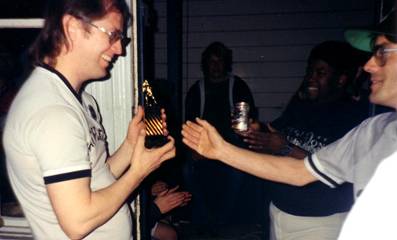
Family and friends joined in. The party began, starting at the field. Mark St. George gave the Brass Beat to John Palmer, who, as Mark said, "came to every practice, came to every game, and dedicated himself to leading The Beat to a championship." The party moved to the little flat on Henry Street where Robin and I lived. She had already decorated napkins with the word "Champions"; Jim sighed in relief that she had not shown them to us beforehand. We drank and drank and drank some more, toasting each other's accomplishments. D'Arcy read aloud the On The Beat article summarizing the season while we all cheered each game.
| |
"I have got to be the luckiest guy in the world. I do not have nearly the talent that every other player on this team has. But because I am a pitcher for The Beat, I have gotten to experience things that many people don't in their entire lives. It is truly something that will last forever. And if ever there’s a night that I can't fall asleep because of all the troubles and cares of life, I know that I can always find comfort thinking about The Beat and how we won our championship."
I still do.
