August 13, 2003
OK., quick: what's the opposite of catadromous?
Give up? Why it's anadromous, of course!
Catadromous fish are those that swim
down freshwater streams and into the sea to spawn. Anadromous
fish perform this migration in reverse. Anadromous fish
swim from the ocean and travel up freshwater streams to
spawn. Salmon, for example, are famous exponents of the
anadromous life, but maybe not for long.
Unfortunately, our rivers and streams
are drying up and what is left of our remaining water resources
is increasingly polluted. All these problems—preventable
problems—are making life difficult for anadromous
fish. Watershed Protection and Restoration Council (WPRC)
has a plan to help anadromous fish make their great leap
forward.
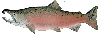
People who traveled in California in the
early part of the 1800's reported seeing crystal-clear
rivers clogged with clouds of salmon. California was in
those days a wonderland of immaculate abundance and natural
generosity. Schools of salmon were so dense that people
scooped them out of the water with just a net on a stick;
didn't need a line and hook.
By the 1850's, the American River near
Sacramento had no salmon at all. What happened? The Gold
Rush happened. The Gold Rush excavated so much dirt, about
eight times the dirt excavated to make the Panama Canal,
that nearly all the rivers in the way died. This dirt in
the Sierras was dumped into rivers where it immediately
killed all the fish; went downstream where it jammed up
the Carquines Straits, and finally created a visible brown
plume 20 or 30 miles beyond the Golden Gate.
Today's "Gold Rush" is
the building boom. County officials permit developers
to devastate open
space and deplete water resources as they scramble to erect
houses, shopping malls, industrial space and huge commercial
centers. The resulting overpopulation from all this irresponsible
building has created so much human waste that the normal
methods of disposal are now inadequate. The building boom
has also produced a water resource bust; we are nearly
out of water in Sonoma County. These burdens are extracting
a grim toll from our environment; the threat to anadromous
fish is analogous to the dying canary in a coal mine: it's
time to do something.