Sonoma County has received
numerous warnings that we are BOTH running out of water
and that
future temperatures will,
on average, rise. We know, right now, that reduced water
levels and rising temperatures means that the present
water crisis is about to get much worse; this is guaranteed.
What we have to do is prepare
for this
looming crisis today.
The most important thing
we can do today is to balance growth (which implies increased
water use) with the amount of water available to us. We
need a groundwater management plan. Luckily, the California
Water Code already has a blueprint for implementing a water
management plan; it's commonly called AB 3030 and can be
found in sections 10750 to 10755.4 of the Water Code.
Approximately 170 other
communities in California ALREADY have groundwater management
plans, there is no reason why Sonoma County shouldn't have
one too. Sonoma County relies on more domestic wells
than any other county.
What warnings?
In 2003, the Department
of the Interior issued a clear warning to all residents
in the American West.
| The American West is facing a serious crisis. In
the long run, we will not have enough water to meet
the fast-growing needs of city residents, farmers,
ranchers, Native Americans, and wildlife.
The demand is increasing; the supply is not.
It is time for Americans to become proactive in our
efforts to resolve the problem.
Crisis management is not a long-term solution. |
U.S.
Dept of Interior, 2003 |
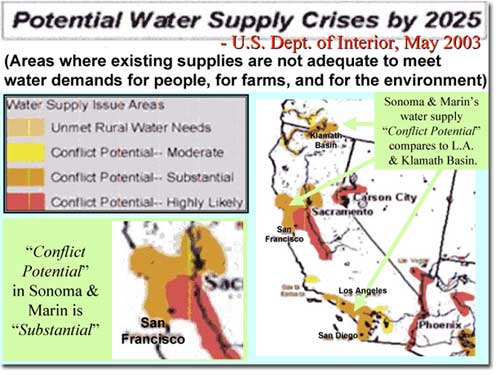
The warning, the result of
a study called: Water
2025: Preventing Crisis and Conflict in the West, Included
maps that predicted areas of conflict over water resources
by 2025 if nothing is done now to prevent those conflicts.

(click on map for a larger
view)
Sonoma and Marin Counties
are clearly identified as having a "dark yellow" status
for conflict. The Department of the Interior interprets
this risk as "substantial". In fact, not only
is there a "substantial risk for conflict" the
risk is calculated as being the SAME as Klamath County.
Conflict has already
commenced in Klamath County and people have been shot and
shot at.
Conflict is no joke and the
warning does not come from overly cautious environmentalists.
The warning comes from one of the most conservative bastions
of the Bush Administration. The Department of the Interior
has no qualms about pumping oil in Alaska but at the same
time sees that some Americans have a high potential to
engage in water wars.
Plenty of warnings
But there have been plenty
of other warnings. A
recent study by 19 scientists representing
as many different disciplines envisioned California's
climate becoming much hotter in the coming decades.
The low prediction was anywhere from four to six degrees
Fahrenheit
increase. This is enough to exert a profound affect on
plants and animals. But the high end prediction is flat-out
scary:
| . . . annual temperature
averages could jump by 7 to 10 degrees. It could
be a whopping
15 degrees warmer in summer. That would make California's
balmy coastal cities feel more like hot inland towns
do now, while "inland cities would feel like Death
Valley does today" . . . |
Another study by an the Pacific
Institute, an Oakland-based independent research group,
revealed that the real
challenge in California's future will not be energy, as
many people believe, but water. Actually, the two are closely
tied but planners have overlooked this important relationship.
The Natural Resources Defense Council published the findings,
which they summarize like this: "Water conservation could
reduce air pollution, prevent blackouts".
| In the western United States,
there is a close connection between water and power
resources. Water utilities
use large amounts of energy to treat and deliver water,
and even after utilities deliver water, consumers burn
more energy to heat, cool and use it. This August 2004
report from NRDC and the Pacific Institute shows how
water planners in California have largely failed to
consider the energy implications of their decisions,
and suggests a model for how policymakers can calculate
the amount of energy consumed in water use. Integrating
energy use into water planning can save money, reduce
waste, protect our environment and strengthen our economy.(click
here to see more) |
Where is the water?
When we think of water resoures in Sonoma
County most people think of the Russian River, various
creeks
and streams, lakes, the Laguna de Santa Rosa, or
massive reservoirs. Actually the County has VASTLY more
water stored out of sight underground than it does in all
of the surface water that we can see.
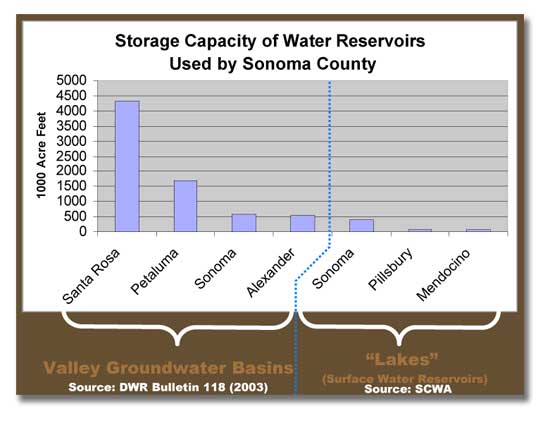
The chart aabove clearly shows
that Sonoma County's water is MOSTLY underground. This
one reason why the County needs a groundwater
management plan pursuant to AB 3030.
Remember, groundwater
levels in the County have been steadily dropping.
In many areas we already have groundwater overdraft,
where more water is being pumped
out of the ground than is able to go back in, a process
called "recharge". In fact, many areas of open
space, areas that
have been identified by the state as "groundwater
recharge lands" have been paved over and built upon.
We need a plan today.
H.R.
Downs, O.W.L. Foundation