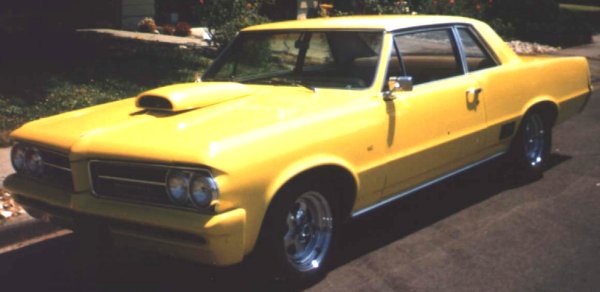
1964 Pontiac LeMans
Funny thing happened in 1992 - the State of California conveniently
changed the vehicle code to exempt '65 and earlier cars from the biennial
smog check program, effective January first, 1993. So, about the
third week in January '93, I got this damn thing, and my life has
never been the same! However, all good (and evil, soul-sucking, money-pit,
road-beast) things must come to an end, and this was no exception. It was
sold to a kid in my area on May 30, 1998.
 When
I started my quest, I was looking for a four-speed '69 Camaro
RS to hot rod. As luck would have it, I found this sucker first.
This car was originally a six-cylinder, three-on-the-tree, gold-and-tan
two-tone, 2.73 one-legged-rear-end granny-mobile. The previous owner had
put in a two-barrel Chevy 305, and moved the shifter to the floor.
When he sold it to me, he made me promise not to hot rod it.
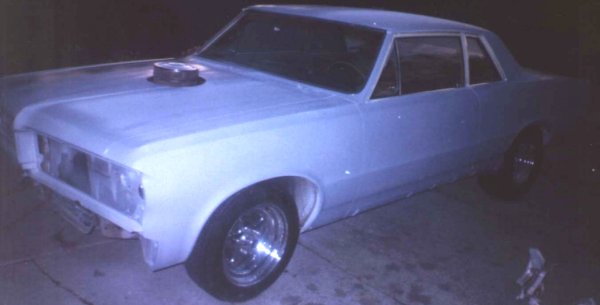
Yeah, right, whatever! That lasted about a month, and then I set
about my dark task, with the help of my accomplice, Darren. In this
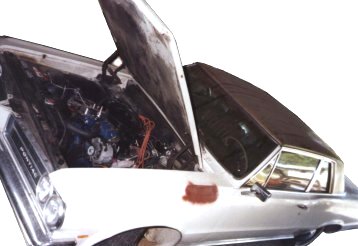
picture, you can see the puny 305, wimpy whitewalls, primer, and super
clean body. This shot was taken as it was readied for a heart transplant.
When
I started my quest, I was looking for a four-speed '69 Camaro
RS to hot rod. As luck would have it, I found this sucker first.
This car was originally a six-cylinder, three-on-the-tree, gold-and-tan
two-tone, 2.73 one-legged-rear-end granny-mobile. The previous owner had
put in a two-barrel Chevy 305, and moved the shifter to the floor.
When he sold it to me, he made me promise not to hot rod it.
Yeah, right, whatever! That lasted about a month, and then I set
about my dark task, with the help of my accomplice, Darren. In this
picture, you can see the puny 305, wimpy whitewalls, primer, and super
clean body. This shot was taken as it was readied for a heart transplant.
 The heart of any street machine is the engine, and this car was to be a
seriously powerful item. I've been told time and time again that
it's either cubic inches or cubic dollars. Planning to go the smart
route, I went with the cubic inches. As I'll explain later,
that didn't end up being such a good call. Oh well, live and learn
I guess!
The heart of any street machine is the engine, and this car was to be a
seriously powerful item. I've been told time and time again that
it's either cubic inches or cubic dollars. Planning to go the smart
route, I went with the cubic inches. As I'll explain later,
that didn't end up being such a good call. Oh well, live and learn
I guess!
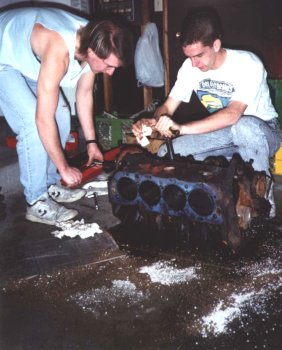
Here, Darren and I are disassembling the 454 Chevy
core. Bought from a local high performance shop, it had pop-up pistons,
steel crank, and oval-port heads. It also had a nasty bunch
of sludge in it from sitting out in his yard for God knows how long.
You've probably been told that oil and water don't mix? Well, take
it from me, it does, and the results aren't pretty.
 The coolest part
about the engine tear-down was the fact that I nearly tore one of
Darren's fingers out. Sorry, dude!
The coolest part
about the engine tear-down was the fact that I nearly tore one of
Darren's fingers out. Sorry, dude!
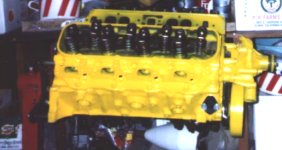 So here's the
finished product, with the paint still wet. As it sits now, it has:
So here's the
finished product, with the paint still wet. As it sits now, it has:
- Keith Black hypereutetic pistons, at 10.5:1 compression
- Competition Cams camshaft
- Weiand Team G intake manifold
- Holley 800 double pumper
- Mallory ignition
- Ported/Polished heads, port matched to the intake
- Timing gears (what a mistake!)
- Hooker headers
I'd be lying if I said I knew just how
much power it makes, but let me tell you this. John Lingenfelter
built a nearly identical engine (same heads and head work), and got nearly
600hp. What I've got would have to be lower, but I'd guess
at least 500hp. If you think I'm nuts, put your money where
your mouth is, and we'll race, toughguy!
As I've alluded to, I have had some problems with this engine.
First time I rebuilt it, Darren worked the block over and then we
assembled it. About three weeks later, I had to yank the cam out,
because it had gone flat. I figured it must have been my fault,
so I bought a new cam and oil pump, and put it back together.
I guess there was too much damage done to the rod and main bearings, and
it died shortly thereafter.
Not one to give up, I rebuilt it again. Not too
long after, the cam gear retaining bolts came loose. I figured I must
have bent some valves, so I pulled the heads off. Let me tell
you, cast iron big block Chevy heads are heavy. The heads
looked okay, but there were marks in the pistons where the valves had been
hitting for quite some time. This is what had caused the cam to go
flat the first time around. I took the engine out and had the pistons
cut for clearance, and reassembled it. When I reinstalled the engine,
I sacrificed a chicken under a full moon, hoping to appease whatever god
I had angered with my mad pursuit of horsepower.
Everything was great for a while (I guess the chicken
ceremony worked), then the oil pressure got lower, and lower, and lower,
until the engine started knocking. Great.... By this time,
I had had more than enough experience tearing the engine down and reassembling
it, so I pulled it out, and had it professionally done. I didn't
have a truck available, so I took the trunk lid off my wife's '70
Nova, and used it for rat-motor transport duty. That thing was way
bottomed out! Anyway, I took the engine to the machine shop,
dropped it off, and said, "Call me when it's done."
 "What was wrong with it?" I can hear you asking. Well,
the machinist called and said, "What do you know about this engine?"
I said, "Huh?!" Turns out the cam journals were oversize.
This allowed the cam bearings to rotate off the oil holes, starving the
cam, tearing up the cam bearings, and dumping a lot of metal shavings in
the oil. Whoopsie! Although it sucked to rebuild the big yellow
menace four times, it felt good to know that it wasn't my fault that it
kept self destructing.
"What was wrong with it?" I can hear you asking. Well,
the machinist called and said, "What do you know about this engine?"
I said, "Huh?!" Turns out the cam journals were oversize.
This allowed the cam bearings to rotate off the oil holes, starving the
cam, tearing up the cam bearings, and dumping a lot of metal shavings in
the oil. Whoopsie! Although it sucked to rebuild the big yellow
menace four times, it felt good to know that it wasn't my fault that it
kept self destructing.
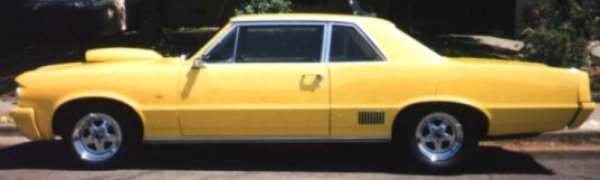
Well, anyway, now it's done, and holey cow does it haul
ass!
Here is the finished product. Click for a larger view.