


|
|
||
|
|
|
|
|
Chapter 05 - The Business Grows; Disaster Strikes |
14 |
||
|
|
|
|
|
About the time this last decorative operation was to begin, there appeared in town from somewhere, -whether by appointment or coincident-, a character who signed his name with a spelling something, like "Columsley". He immediately became known only as "Clumsy", and he accepted the nickname cheerfully and without rancor. Clumsy was a happy good-natured chap quickly entered into the activities of the town, especially, making the rounds of the bars and saloons each evening. So, it soon became known that his trade (unusual in an isolated camp) was professional painter and paper hanger. Clumsy soon garnered the job of decorating the new hotel, and his skill amazed the natives. With a mouthful of tacks and a long nosed magnetic hammer, he could tack the muslin lining in a whole room, ceiling and all, while an unskilled workman covered one wall. The four foot nine wainscoting around the hotel lobby and bar-room might otherwise have looked rather drab; Clumsy painted and grained each four inch board around these large rooms so that, without close examination, they appeared to be made of polished light oak. It was during this period that Daisy hired the first new employee to help operate the hostelry. Most of the hotel boarding house cooks at the time were chinese, but Daisy vehemently disliked chinese cooking. So through some contact with the outside she had hired Mattie Wilkins |
||||||
|
|
||||||
 |
||||||
|
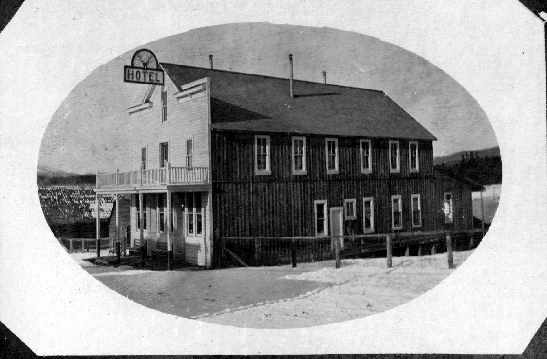
The original unit of the Hotel was completed by the time the snows came in the fall of 1906 |
||||||
 |
||||||
|
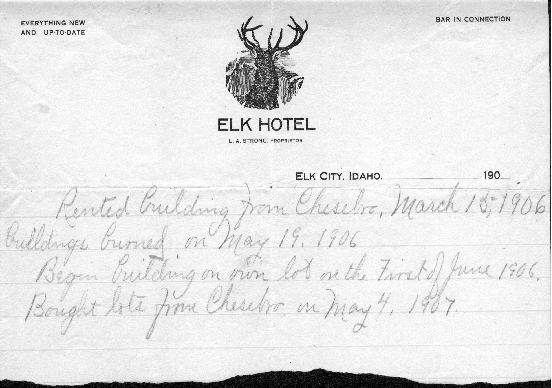
On stationery of the new Elk Hotel, Daisy made notes of the dates of events as they occurred. |
||||||
|
By the fall of 1906, before the snows came the hotel was completed and the proprietors with all their patrons and customers moved in. All rooms were immediately filled up and dining room patronage so increased that soon a waitress, in the person of Minnie Brown (later Mrs. "Sliver" Thompson) was employed. It was immediately obvious that the new building would be completely inadequate to accommodate the business which was, and had been for some time, increasing steadily. Some historians pin - point a period in the late 1890's and Early 1900's when a resurgence of interest and excitement in hard rock, or lode or ledge mining began creeping through the entire western mining fraternity. This excitement seemed to touch every one, from mucker to engineer, from gambler to financier, from laborer to business man within the gold and silver communities. And naturally so, for in that Idaho area alone, were men who had seen the diggings at Pierce, and at Warren, and at Florence, and Murray and Burke and Wallace. It was reasoned that the placer gold from these and many other camps must have been originally deposited in ledges which dropped the gold as they were eroded over the millenniums. It remained only for the lucky prospector to find these ledges hidden in the forests, amid the underbrush, and under the soil which had been deposited over the centuries. Furthermore, everyone still remembered the great Comstock Lode, and it was still under sporadic exploration. And it was -the era of the booming camps of Cripple Creek, Colorado, and Rhyolite There was Goldfield, and Telluride, and' Butte, and the Montana gold discoveries. Many men had made their fortunes in these scattered camps of the West, and so it was small wonder the imagination of others was stimulated to venture into these remote and more or less lawless settlements. They were stirred, by a subtle undercurrent of excitement and adventure which permeated the circuit of the gold camps,- an excitement not known or recognized by people who followed other pursuits of commerce and industry. Usually a good portion of the gold camp population was transient, good business for hotels. People whose fortunes or luck was not approaching expectations in one mining town, hearing rumors or reports of a "boom" in another camp, would move on. Miners, muckers and prospectors made up most of the population, with a fair sprinkling of woodsmen and timbermen, horsemen and teamsters. Of necessity, there were the assayers and surveyors; and inevitably there was the following of gamblers, pimps and prostitutes. Mining men and their "experts" would come and go. Roughly defined, a "mining man" was expected to be a representative of a Company or Corporation supposedly having quantities of capital to buy or option and develop new mines. "Expert" was a term sometimes derisively applied to his adviser or "man Friday", a person usually attired in breeches, high- boots and stetson hat. He might be a graduate engineer, or just an ex-straw boss, with enough knowledge of minerals and geology to take samples and guess at the value of an ore body. Under the circumstances at the time, the only way for a hotel to take advantage of expanding business was to increase its facilities. So, Billy Johnson was again called into consultation and plans were made to almost double the size of -the hotel by building an addition to the rear on the same lot. At the same time negotiations were started for the purchase from Mr. Cheseboro of the two lots to the west, a transaction completed May 4, 1907. As soon as weather permitted the new addition was started. It stretched so far back over the contour of the hill that the rear end of the house had to be supported by posts seven or eight feet high. This, however -made room for an enclosure as a "basement" for storage and work shop. It also provided room for a cellar, a small room with sawdust filled walls two feet thick. Here fruits and vegetables and other freezable supplies for the kitchen could be stored in winter. This afforded fair protection, but even so, on the coldest nights one or two lighted kerosene lanterns had to be hung in the cellar to ward off the frost. |
||||||
|
|
|
|
|
|
|
|
|
||
|
|
|
|
 (later, Mrs. Bill Boyd), a young lady about her own age, to help with the operation, including cooking and table waiting.