
These are images of my trip to Lviv, Ukraine (formerly Lvov, Lwow, Lemberg) in September 1999.
Despite being ruled by five nations during this century, most of Lviv's buildings has survived, as the city has been spared bombing. The larger boulevards maintain a old western feel recalling the Austro-Hungarian Empire of which the city was once part.

The former Jewish hospital, done in a Moorish style entirely uncharacteristic of the region, is gorgeous.
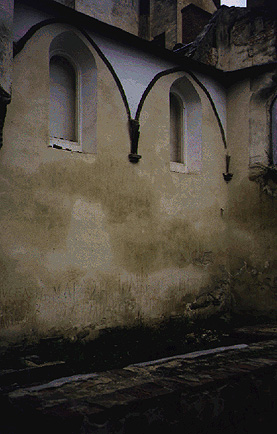
Many of Lviv's destroyed synagogues are now vacant lots. The ruins of the famous Renaissance era Goldene Royz Synagogue still stand much as the Nazis left them.
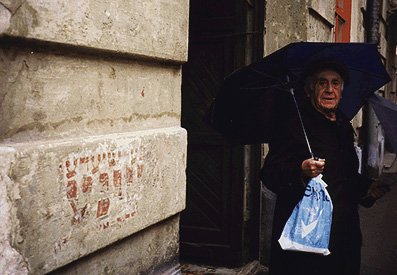
Throughout Lviv's once lively Jewish districts, there are only the faintest of clues to the rich past. Here, Yitzhak Meler, who generously gave me several extensive walking tours of the city, stands beside the remains of a Yiddish sign on a wall. Yitzhak has lived in Lviv most of his life, and now lives on a pension of between $20 and $25 a month. Having entered the Soviet Army during World War II, he was one of very few residents of Lviv to survive and return to the city. His entire family perished in the Shoah.
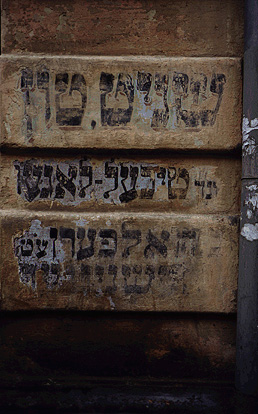
Remnants of another Yiddish sign.
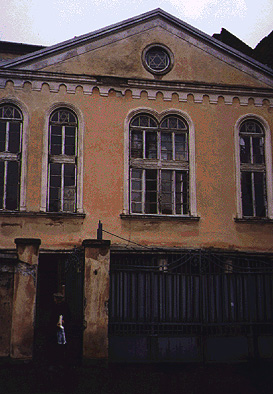
This is one of two synagogue buildings, out of dozens, to remain standing after the War. After Ukraine gained independence, it again became a functioning synagogue. The rabbi is an American-born Hasid (Karliner, I believe) who has been here for six years. The shul has a daily morning and evening minyan, in addition to Shabbat services..
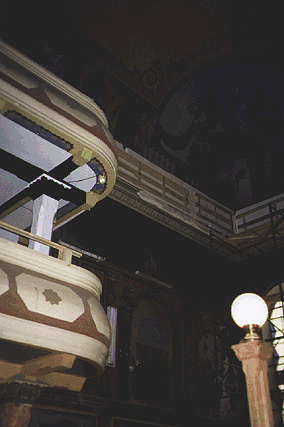
The image, unfortunately, is poor, and doesn't reveal the beauty of the synagogue's interior. Paintings cover the walls and ceilings. The first balcony is still used as the women's section.
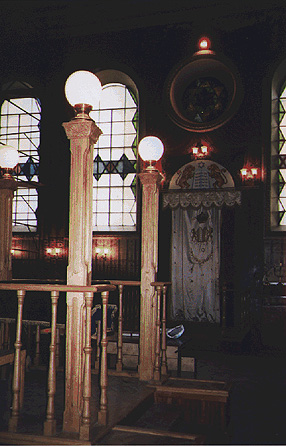
The Torah is read from the central bimah.
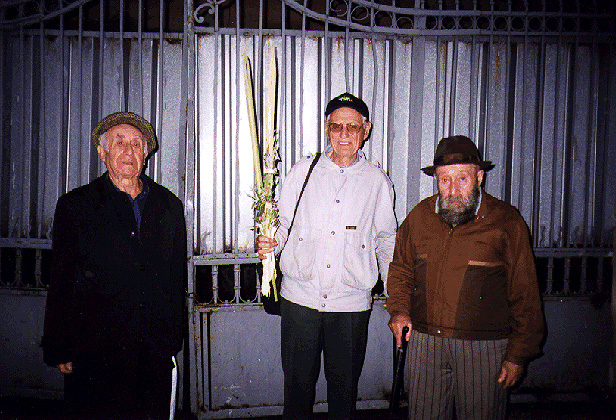 Three
men in front of the shul after ma'ariv during hol ha-mo'ed
Sukkot.
Three
men in front of the shul after ma'ariv during hol ha-mo'ed
Sukkot.

The other surviving shul building, used as a stable by the Nazis, is now a center for the Jewish community. It has offices, adult educational programs, a Sunday school for children, Yiddish theater, vocational training, a pharmacy, a hesed program, and more.
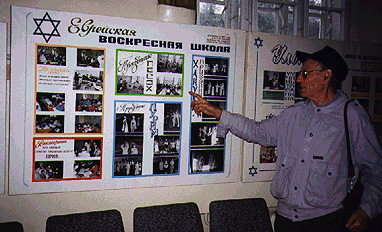
Boris Dorfman, a Yiddish writer and historian, points with pride to the activities of the Sunday religious school, which is run by his wife. Boris was born in Kishinev, Bessarabia, but has taken a great interest in the history of Jewish life in his adopted home.