© John R. Wallace 2008 last updated: 5-jan-09
General Comments:
Like the previous chapter, this, too, is a very brief chapter but while that chapter delivered a number of important turns in the narrative this chapter is more sleek. Basically it tells us of Genji's ill-fated amorous encounter with the youngest sister of his most dangerous political rival, Kokiden. The name we know her by is based on a comment she herself makes about the misty or romantically indistinct moon that is associated with spring moons: oborozuki (朧月). While the previous chapter turned our gaze to the stage where Genji and Tō no Chūjō dance so beautifully, the narrative gaze in this chapter is more what happens after hours and away from the public arena. The young Oborozukiyo, "Night of the Misty Moon" may or may not be of the same daring nature as "Evening Face" (Yūgao) or Dame of Staff (Gen no Naishi no Sue). That depends on how you judge her actions and the narrative manner in how she is introduced. Either way, Genji's romantic error with her will play itself out in Genji's public life as the opportunity Kokiden was looking for to exile Genji.
Personally, I think it is better to avoid a stark "friendly camp / enemy camp" dichotomy in gauging Genji's behavior. While it would seem to be ill-advised, and is, for him to wander about inebriated in the women's rooms governed by Kokiden, the text is clear that he worries if Oborozukiyo's father, the Minister of the Right, discovers the relationship the minister might take him in as something like a son-in-law (rather than treat him as incurring on off-limits territory--S154 "supposing her father ..." T158 "what if His Excellency her father ...") because Genji is thought by most to be headed towards great political success; thus, to have him as an ally, in the long run, would serve the minister's interests better. Given this context, it seems better not to think of Genji's action as either overtly transgressive or rash in the extreme. Genji works under considerable protection, being comfortably surrounded by many friends, and he is aware of this. It is not one of his better thought-through nights, but neither is it completely stupid behavior. Genji shouldn't be seen, in my opinion, as likely to be ready to throw aside his reputation for a single night of love or as someone who uses sexual behavior to strike a political blow on an enemy. Murasaki's Genji is, I believe, more careful, nuanced and complex than that.
Notice how, yet again, Genji discovers a new amorous partner on his way to a lover, in this case Fujitsubo (who has prudently locked her doors for the night).
Murasaki, in a brief passage, is shown as yet again just a little bit older. (Another New Year's season has come and gone, though it occurs between the previous chapter and this one — an omission, by the way, that to my mind supports the public/private contrast of these two small chapters.)
Although not very forcefully narrated, there is a subtle sense of criticism of the Kokiden group as lacking the elegance that comes from having a bit of complexity or "shadow," and that perhaps Oborozukiyo's indiscreet behavior is a symptom of something deficient in the elegance training of the Kokiden women. The "brightness" and simplicity and slight recklessness of this group calls to mind Murasaki's description in her journal Murasaki's Diary (Murasaki Shikibu nikki) of another cultural salon which delicately alludes to the doomed cultural salon that was built around the imperial consort Teishi that included Sei Shōnagon; it was the dominant salon until the death of Teishi.
Basic Story Summary:
In the 2nd month of the year that follows the previous eventful year when Fujitsubo gave birth and became empress, Genji and Tō no Chūjō again are seen dancing. After these festivities, Genji thinks there might be an opportunity to visit Fujitsubo; however, she has bolted the door. Having been drinking, he wanders into the Kokiden complex of rooms, finds an open door, encounters a woman (15 years-old) who has stepped near the entrance way of that door to comment on the moon, grasps her sleeve, and sleeps with her. She seems aware of who he is but doesn't give him enough information for him to determine who she is, though he thinks it likely that she is one of Kokiden's sisters. A month later he is again at the Kokiden apartments and is able to deduce that it is the youngest sister. As the end of the chapter says, "He is pleased but ..." (いとうれしきものから)
Reading notes:
Seidensticker 150 / Tyler 155, lunar phase:
Seidensticker's "towards the end of the second month" obscures the precision of the timing. As Tyler writers, it is "a little past the 20th of the second month". At this phase the moon would rise around 11:30PM (during the time of year when the sun sets at about 6PM, a little earlier in this case). That leaves the waning gibbous moon high in the sky by the end of the night — enough light for lovers to return to the proper residences but dim enough that identities are protected. This moon that begins a few days after the full moon and continues for a week or so should be considered particularly romantic because of this traveling advantage and its beauty in the dawn sky.
A waning, gibbous moon:
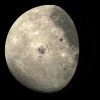
The moon of this chapter, the 二十日余の月 (hatsuka amari no tsuki) is just a little less full than this.
Charts of moon phases, their sky position, and various premodern Japanese names are in most classical Japanese dictionaries (古語辞典, kogo jiten) and, of course, online. Moon phase online information in English also abounds.
Seidensticker 151 "He went up quietly to her apartments" & "from the north":
The "up" and "from the north" are not in the original, though the latter can be implied. By "up" he means a step up onto a veranda from the courtyard, which is a possibility. He does not mean a second story; there are none.
Seidensticker 151 / Tyler 156 "this is how a woman invites her downfall" (S):
Tyler provides a footnote suggesting that Genji is being critical of Kokiden mores though, he suggests, the comment ought to apply to Genji himself. It is a subtle point but to my ear "downfall" is a bit extreme though it is emphatic language: かやうにて世の中のあやまちはするぞかしと思ひて. It seems not quite natural to place the statement entirely as a judgment by Genji of Oborozukiyo's choice to stand near her doorway, since he is about to take advantage of the action. My reading places this comment more ambiguously as half-commenting on her, half-commenting of the risk he is taking, on the one hand, and, on the other, as half-thought by Genji and halfway a remark made by the narrator, judging the risky ambiguity of the situation. How to read this passage depends, in part, on how one interprets comments like "She came (could you believe it?) to the door" (Seidensticker 152) (こなたざまには来るものか) which can be a criticizing type of surprise that she does not take more care about the possibility of being seen or a delighted surprise at his good fortune that she is within reach.
There is a lingering question here of whether the 15-year-old Oborozukiyo is a virgin and, with that, whether she has intentionally tempted the approaching Genji (somewhat the way Yūgao did) or is just innocently, if romantically, gazing at the moon entirely unaware of what is about to befall her. I don't think this question necessarily needs an answer; Murasaki might be wanting it both ways. Tyler takes her to be a virgin. This is consistent with his view of Genji and a fair interpretation of the NKBZ note, which I would think he read, that glosses the 人に馴れぬ as 男女関係を知らぬ、うぶな人。However, she offers a very seductive, practiced and alluring poem for someone who recognizes that she is about to sleep unexpectedly with a man for the first time. So, to my mind, it is a bit difficult to take her to be entirely inexperienced.
Seidensticker 153 / Tyler 157, the lovers' frames of mind just before making love:
"... could not admit the possibility of letting her go ... [Oborozukiyo] did not know how to send him on his way" (S) and "because he felt he must have her, .... she probably never thought seriously of resisting him" (T) (ゆるさんことは口惜しきに、,,,強き心も知らぬなるべし). I think Seidensticker is definitely closer in this case. "Have her" seems overly inelegant for the narrative voice of this tale and for the precise psychology of the moment that is, I think, less driven by implacable passion as by a romantic situation — the moon, a beautiful young girl alone, an inebriated state — that leads something to "just happening" so-to-speak.