© John R. Wallace 2008 last updated: 18-jul-12
General Comments:
This chapter presents a number of narrative lines:
Rokujō leaves Genji for Ise Shrine (a substantial distance from the Capital, this is really leaving town) where her daughter Akikonomu will be Shrine Virgin (and, as a minor point,
Asagao becomes the Kamo Shrine Virgin),
Genji's father dies and with that death the political landscape becomes hostile to Genji,
Fujitsubo becomes a nun,
Oborozukiyo and Genji are caught together.
Briefly put, Genji's life collapses in this chapter, though in the previous chapter the first movements of this were already present.
This chapter is famous for its scene where Genji visits Rokujō at Nonomiya (thus the icon selected for the top of this page). The paragraph that describes his journey across the field to her place is, to my mind, particularly beautiful. Probably the next most standout scene is Fujitsubo becoming a nun, followed by Genji's indelicate position as he is caught by the Minister of the Right hiding in his daughter Oborozukiyo's bed, his face hidden by covers.
Religion (and transgressive behavior) is strongly present in this chapter.
The sakaki branch, which Genji uses in his poetry between both Rokujō and Asagao, is common in Shintō ceremonies. In times even more ancient than this Heian period, gods were associated with plants, that is, they were believed to lodge in plants, and in particular they lodged in plants with point-tipped leaves (such as the pine tree) and/or thorns. The sakaki is a camellia family tree, not a conifer, but its leaves are glossy and very healthy-looking, and prominent at the tip.
In addition to this Shintō referencing (which one could say is interestingly ambiguous in that Genji transgresses sacred ground by seeing Rokujō and by corresponding with Asagao), Buddhism has two very prominent roles in this chapter: Fujitsubo taking tonsure and Genji secluding himself at his uncle's (mother Kiritsubo's side) "Cloud Mountain Retreat" (雲林院, Urin'in) north of the capital's outskirts as he explores whether he can commit to becoming a monk. (Of course, we should also mention the Buddhist ceremonies that would surround the death of his father.) In the context of these soul-searching choices made by Fujitsubo and (not) made by Genji, his very risky visits to Oborozukiyo seem almost comic, except that part of me thinks that his judgment is warped by the sudden dismal nature of his political situation and that his risky amorous adventure is just an all-too-human reaction to this.
Politics is, of course, huge in this chapter. Genji's half-brother Suzaku is not negatively disposed to Genji but he is controlled by his mother Kokiden and father, the Minister of the Right. With their rise in power, all those associated with Genji's father, including the Minister of the Left, suffer a dramatic reduction in political possibilities.
There are two scenes in this chapter I find "extreme" but in different ways.
The first is straight-forward and depicts Genji's very intense feelings for Fujitsubo. He can hardly control himself saying, strikingly, at one point "I would gladly die of shame than have you hear I am still alive" (Tyler 204)(世の中にありと聞こしめされむもいと恥づかしければ、やがて亡せはべりなんも、)
The second puzzles me. Rokujō is the murderess of his wife Aoi and when this fact is kept in mind, his conversation with her, his attraction to her, and his attraction to her daughter, all seem odd to me, in that he (or the narrator) seems to be able to put this fact behind him.
Part of me thinks that perhaps principle ("Do not love the person who killed someone you loved") or literary psychological realism ("In X situation, Genji should think/feel ...") should not be the primary reading element here.
One might consider reading it more situationally: Aoi is dead, there is nothing that can be done about that, and here is the woman who loved him so much that she engaged in a desperate — granted not well chosen but certainly passionate — act to draw him to her. Could Genji simply be drawn to her fire for him when he goes to see her? It is a complicated affair, and very interesting to turn over in one's mind.
Or one might think that Murasaki, rather than being primarily interested in realism, selects a lyrical, specific aspect of the situation, and wants most to explore only that.
Also we can keep in mind that Genji is almost never angry about anything.
... And yet, the narrator does say in Chapter 12 "Suma" that his "unfortunate" or "sad" (うし) attitude about her with regard to Aoi was "mistaken" (一ふしうしと思ひきこえし心あやまりに、 NKBZ 2:186).
I asked a student of mine, Pooja Jajodia, a young women whom I consider to be a careful thinker, and who has written a novel, to think this chapter over and send me comments. I wanted a woman's considered opinion since I feel that part of my conundrum on this point could be gender based. I'm including her response:
Lady Rokujo and Genji's relationship pre-exists before the novel like a
man's relationship with his karma exists before a birth. Considering the
tension throughout their relationship, especially after Rokujo kills Aoi,
I thought Genji might be fascinated/horrified with the karmic bond that
ties him to Rokujo. He may wonder what sins he committed in a earlier life
that now ties her to him, and it's the possible intensity of these sins
that draws him to her.There's also the danger of being involved with her. Genji is drawn to
competition and reputation. He cannot see Fujitsubo or Rokujo as closely
as he would a woman of lower social ranking, so his feelings stem from
thrill of being close to "forbidden" women and his own image of what they
look like. ...As you had mentioned, I thought it was the intensity of Rokujo's
personality that draws Genji to her. I imagine Rokujo as a void everyone
falls into because they they cannot know her any other way.When Genji witnesses Rokujo's spirit beseeching him for his affection
through a weak, and pregnant Aoi, he realizes how deeply she loves him. Or
loving him to the extent that she becomes possessive. Aoi on the other
hand is never outwardly possessive. She hardly calls on Genji for his
wandering eye and it's this frozen demeanor that makes her inhuman,
unapproachable. Genji is uncomfortable in her presence as he prefers
delicate and weaker-willed women. We weren't assigned the reading for
this, but later in the novel when there's a thunderstorm, the Akashi Lady
doesn't rush to Genji for comfort - in fact she's the only one who remains
calm in the Rokujo Manor - which bothers him immensely. I'm imagining it's
the same thing for Aoi as Genji wants to be dominant in his relationships.
Rokujo is an interesting case in that she's contradictory. She allows him
to feel strong by being in control of her emotions, but on the other hand
reminds him of his human weakness by allowing her spirit to haunt him.
This deception alone is alluring.Or: Considering how his wife is indifferent and Fujitsubo has no choice
but to be indifferent, Genji takes solace in Rokujo in that she's a woman
of power but isn't indifferent. She may be possessive in a horrific way,
but the sincerity behind her actions is touching. Rokujo could be a
substitute for Aoi and Fujitsubo, which puts her on a different level than
Murasaki who was only a substitute for Fujitsubo. But Fujitsubo started
out as a substitute for the Kokiden Lady, in different respects for Genji
and his father of course.....but I'm not going to get into that.Now getting onto the heart of the matter: why he goes to Rokujo after Aoi
dies. Genji saw the manifestation of Rokujo's soul in Aoi. For a woman of
such beauty and dignity, seeing Rokujo violent and vulnerable is
unnerving. He goes to her see if she physically manifests this violence;
to see her again in a different light if you may. It's like how people on
the street stop to look at a traffic accident: they want to see the
damage. Genji is curious about the damage he's caused and wants to see it
in physical form. Shikibu notes how distressed he is when Rokujo leaves,
so there's an element of humility in his curiosity. He goes to her not
only because he's drawn to her possessiveness, or her rank/reputation, but
because he's also guilty. Her sadness is powerful.One becomes more intimate with someone when they see them in their most
vulnerable state. Rokujo was in her most vulnerable state as a wandering
spirit; for her ranking, revealing herself this way may be equal to coming
before a man. Catching a glimpse of her this way is as if seeing her
through her blinds: temporary, but intense.There's also the thrill of being close to someone so dangerous. Or less
dramatically, perhaps Genji is afraid. Going to her would soften her
violent feelings so he could avoid confronting her spirit again, but of
course this isn't the case.Even less dramatically, perhaps he goes out of social obligation. But that
cannot be the reason alone. It's part of why he visits her after Aoi dies,
but it lurks behind the larger attraction Genji feels towards Rokujo.I might add that centuries later the Noh play "Nonomiya" — which takes as its scene the visit of Genji to the departing Rokujō when she is staying at Nonomiya with her daughter undergoing purification before continuing on to the Ise Shrine — also focuses on Rokujō's lonely longing and the shame she incurs from the carriage confrontation at the Kamo festival described in Chapter 9 "Aoi." Genji's frame of mind is entirely irrelevant to this play except that he is described as deeply affectionate (わりなくも), and "noble and sensitive" (情をかけてさまざまの、言葉の露) (Varley translation in Keene's 20 Plays) for traveling to see her.
Rokujō is indeed mysterious. Enchi Fumiko (Masks and in essays on Genji published elsewhere) has accurately observed that Rokujō's origins in the story are hidden in a way that other women's are not. We are given some details of her past in this chapter: she entered service as a consort to the crown prince (brother of Genji's father) when she was 16 and that prince died when she was 20. Since she is 7 years older than Genji, he was at court when she was consort, but we hear nothing of it. In some ways, Rokujō arrives to this story in a disembodied, ghostlike way. (Also: the death of Yūgao may or not be by her hand.)
Genji's "habit/quirk" (癖, kuse) is noted with clarity in this chapter and referenced a second time to peg it clearly into the narrative. The first case is when he shows an interest in the young Akikonomu, who is Rokujō's daughter and now set to be a Shrine Virgin and is much younger than him (the same age as Murasaki). "Difficult and unconventional relationships always interested him" Seidensticker writes (189); "Seduced as he always was by strange complications" Tyler writes (197) (例に違へるわづらはしさに、必ず心かかる御癖にて、)
Also rather prominent in this chapter is the intrusion of the narrator's voice. She clearly places herself "on scene" in her choice of language, and she is in Genji's camp. This is more evident in Seidensticker's translation than Tyler's since Tyler's use of indirect language ("one", not "I") depersonalizes it a bit. (See Seidensticker 205, 210 / Tyler 211, 217)
In a tale wrapped almost entirely in dreamy mist, one comment really stood out to me as something that pricks that bubble, a rare sharp angle in Murasaki's narrating.
This is when a nephew on the Minister of the Right, a young man who is suddenly enjoying political good fortune, says to Genji as he passes: "A white rainbow curved across the sun; the Heir Apparent trembled." (Tyler 209). As Tyler's footnote explains, this is a direct threat to Genji and (his secret son) the Crown Prince. But even without the footnote (I was reading Seidensticker for this chapter) it has a strangely mean tone to it. It makes Genji look small, and this is very rare in this book.
Fun-and-oddity corner: the decayed teeth of the Crown Prince described as charming (Seidensticker 199 / Tyler 205).
Basic Story Summary:
Rokujō, deeply disappointed by Genji's attitude towards her, and deeply troubled by her actions with regard to Aoi, determines to leave with her daughter Akikonomu for the Ise area. Akikonomu has been given the honor of the post of Ise Shrine Virgin.
9th month 7th day, Genji's 23rd year: Genji goes to see Rokujō in their temporary residence at Nonomiya, where Akikonomu is purifying herself. Shortly afterwards, Rokujō and Akikonomu leave.
Genji's father, the Retired Emperor Kiritsubo, grows ill and dies. Genji sees Fujitsubo several times during the course of this chapter, but she maintains a stubborn distance from him.
The political world shifts towards the Minister of the Right with the passing of the retired but very influential Kiritsubo emperor. The Minister of the Left eventually retires from government service.
Genji laments the many difficult turns of fate that have befallen him. However, during this period Murasaki's position grows stronger.
Asagao becomes Kamo Shrine Virgin. Genji and she exchange poems now and then.
Fujitsubo decides to take Buddhist vows, and does so at a well-provided-for ceremony. Both Genji and Fujitsubo's brother are shocked at the unexpected news. Genji now realizes that he must somehow look after the Crown Prince (his secret son) since that emperor-to-be does not have many supporters in the lay world. Genji tries to turn towards Buddhism by spending some time in a mountain retreat (Urin'in) run by the brother of his dead mother but returns to lay life at Nijō, recalling his love for Murasaki and perhaps his duties to Yūgiri and indirectly the Crown Prince.
At great risk, a despondent Genji continues his relationship with Oborozukiyo who has been promoted and is now more or less a minor consort of Emperor Suzaku. (Remember that Fujitsubo was also consort to an emperor, as was Rokujō.) Her mother has given her the Kokiden apartments. (Since Fujitsubo has left for her original home, having taken Buddhist vows, the Fujitsubo rooms are occupied now by people friendly to Kokiden and her group. One of these sees Genji leaving Oborozukiyo's Kokiden one night, since that wing is directly across from the Fujitsubo wing.) At the end of the chapter they are discovered together by Oborozukiyo's father, the Minister of the Right. He had known of the relationship (as did Suzaku) but wanted to look the other way. Lady Kokiden, on the other hand, is livid with anger and begins to plot actively against Genji.
Two New Year seasons pass during the course of this chapter but they are not festive; rather, they accent the dreary turn of events.
Reading notes:
Seidensticker 186, Genji's travel to Nonomiya (野宮):
"It was over ... what was being played." This passage is just gorgeous in the original.
The beautiful Noh play "Nonomiya" (Shrine in the Fields) is translated in Donald Keene's 20 Plays of the Nō Theatre
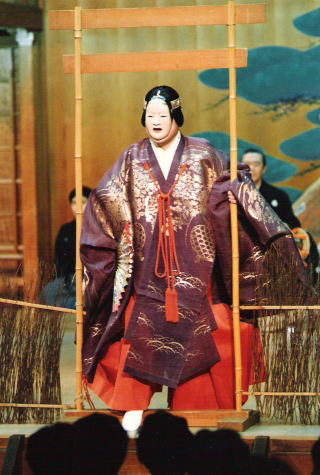
Link to Jse page that carries this photo and several other very good pictures of the Nonomiya Shrine.
Seidensticker 188 2nd paragraph below last poem / Tyler 196 top of page, moon location and brightness:
Genji visits on, by moon standards, a beautiful evening but a darkened night. Rokujō's glimpse of him in the moonlight should be considered very dim indeed. This time during the month is not particularly romantic but Genji's timing is forced because of the upcoming departure to Ise. Seidensticker's "The shadowy figure in the moonlight" misses that the moon is well gone by dawn. This comment refers to Rokujō's memory of him earlier in the night. Tyler catches this.
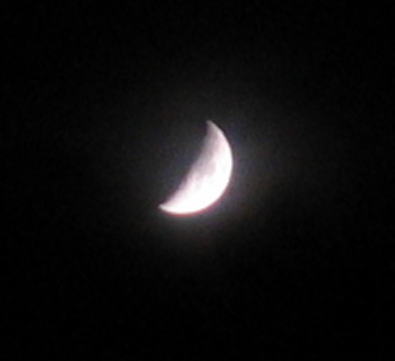
the 7th day moon; this moon sets by the middle of the night

the 7th day moon in the evening; this moon is visible during the evening hours
Seidensticker 188 Rokujō's lady's attitude:
"What kind of journey ..." Do these women not know that their lady is the one who killed Genji's wife?
Seidensticker 188 / Tyler 196:
"Warm and tender" (S) / "unusually expansive letter" (T) (こまやかなる) Literally this means something closer to "to write in detail [and with care one's emotions]" ... This phrase is used regularly in Heian writing to describe a love letter that has more than the usual effort put into it. Then, I've noticed, when it is translated, we tend to use whatever English fits our concept of what such a letter should have in it. However, in my opinion, from the Heian point of view, we should think that it has been written with care (a sense of time put into the language and thoughts) and probably talks about the feelings of the writer rather than be an attempt by the writer to show that he understands the feelings of the recipient. (This may be simply wrong but as a casual comment: My memory is that こまやかなる refers more often to men's letters than women's, perhaps because women's letters are, by default, thought to be written with care while men had the freedom to be more hasty, at times. Or perhaps because it was inappropriate for women to write at length. This could well be an over-interpretation, I just jot down the thought. ... A counter example to this is in Chapter 12 "Suma" where Fujitsubo writes in response to Genji while he is in exile. S232 / T241) However, there are definitely exceptions such as when a letter is sent in condolence or during bad weather (the lover shows that he understands the dreariness of the day for his woman), and so on. So we should be ready to think of such an extended letter as either "about me" or "about you" depending on the circumstance. "Warm and tender" (S) is definitely inserting a strong cultural point of view about the content. "Expansive" (T) is closer to the original but somewhat neutral as a romantic term.