© John R. Wallace 2008 last updated: 5-jan-09
General Comments:
This is an exceptionally short chapter, but it is a lovely summer night with the fragrance of orange blossoms (and katsura) in the air and the unpretentious and sweet lovesong sound of the hototogisu (lesser cuckoo). Genji visits three women this night. The first refuses him, the others are sisters. The youngest of these sisters will be called Hanachirusato ("Hamlet of Falling Flowers") and will be one of the women he eventually brings to his estates complex. The older sister was consort to his father.
Hototogisu (lesser cuckoo, Cuculus poliocephalus)
(link to Jse page that is the source of the below picture, includes multiple pictures of various springtime birds, plus explanation)
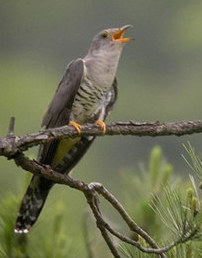
Link to sound file (wiki entry on Lesser Cuckoo)
The timing of this chapter is worth considering. It is just past the 20th night of the 5th month, so just past mid-summer in the classical count (months 4-6). We know, too, that Genji's unfortunate night when the Minister of the Right catches him in the bedroom of his daughter Oborozukiyo is also during the summer. That event has probably already occurred. This chapter regresses in time and so is positioned close to that event. This pattern is true of Chapter 5 "Wakamurasaki" and Chapter 6 "Suetsumuhana" with a similar juxtaposition between the major female character Murasaki and the more secondary character Suetsumuhana (Safflower Lady).
This is a chapter of memories:
the orange blossom (tachibana), with a distinctly rich fragrance valued during the Heian period (but later considered too fragrant with the faint color and scent of the cherry preferred), was treated in Heian poems as a flower that recalls the past and past lovers;
Genji visits with the Lady Reikeiden, his father's consort and they recall the (better) past; and,
in general this is a chapter when Genji feels the loss of his more fortunate days.
Tachibana (Citrus aurantium var. tachibana)
(link to the Jse page that is the origin of this photo, includes several other photos of the leaf, fruit, flower and tree and numerous passages from classical texts)
*I think the tachibana is the only Japan indigenous variety of citrus trees.
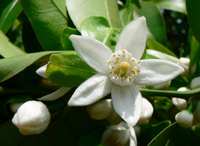
One of the poems from the Kokin waka shū (Summer, 139) that uses the orange blossom fragrance:
さつきまつ / satsuki matsu
花たちばなの / hana-tachibana no
かをかげば / ka wo kageba
昔の人の / mukashi no hito no
袖のかぞする / sode no ka zo suru
Smelling the scent
of the orange blossom
that waits the Azalea Month [5th lunar month, mid-June]]
I smell the perfume
of one from my past.
Several times already in the story Genji has been described as visiting a variety of minor women but we have not been given details. Perhaps this is an example of one of those nights.
Also notice the continuing of a pattern: visiting or discovering one women while on the way to another.
Basic Story Summary:
On just past 20th night (hatsuka amari) of the 5th month of Genji's 25th year (the same time of the month where he first visited Oborozukiyo, see Chapter 8) he goes to visit his father's ex-consort the Reikeiden Lady and her younger sister Hanachirusato. On his way, he tries to visit a woman he knew briefly but, in an exchange of poems with Koremitsu as the go-between, she pretends not to remember him.
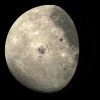
For notes on this moon phase, see: hatsuka amari no tsuki
Reading notes:
Tyler 223 / Seidensticker 215, what women are on Genji's mind?:
"secret consuming sorrow" (T) "Genji's troubles" (S) (人知らぬ御心づからのもの思はしさ). ... NKBZ annotates this as Fujitsubo and Oborozukiyo, but I don't this we have to commit specifically to a particular name(s).
Tyler 223:
"His Late Eminence" refers to the Kiritsubo Emperor.
Tyler 223 / Seidensticker 215, regarding where Genji is on this night trip:
"Nakagawa" (T) "Inner River" (S) (中川) Flowed in a southerly direction in the eastern portion of the capital and this particular area had a number of villas, a good neighborhood just outside the Capital. In Tales of Flowering Fortunes translated and annotated by Helen C. McCullough, we read this footnote description: "The Nakagawa, or Middle River (so called, according to one theory, in contradistinction to the Eastern River, or Kamo, and the Western River, or Katsura), followed a southerly course from its source north of the capital, passing east of what is now the Shōkokuji ... , it gave its name to a villa area where members of the nobility sometimes went to escape the summer heat or to avoid a directional taboo. Readers of The Tale of Genji will recall the area as the site of the house owned by Kii no Kami where Genji met Utsusemi." (p. 173-74)
Tyler 223 / Seidensticker 215, music style:
"azuma mode" (T) literally something like "tuning the expressive koto in an azuma way Eastern mode" (よく鳴る琴をあづまに調べて) but scholars are not entirely clear what this means except a type of lively, if not on the loud side, music. "Azuma mode" is not one of the true six modes of gagaku music.
Tyler 223 / Seidensticker 215, the laurel tree:
cercidiphyllum japonicum, known these days primarily, I think, by the name "katsura tree". Seidensticker's footnote identifying it as the Judas tree (Cercis siliquastrum) is, I think, wrong though he must have had a reasons for specifying it. The katsura is a very large tree, by the way.
Tyler 224 / Seidensticker 217, Genji's attitude towards women:
"He seems to have cared forever for each one of his lover" (T) "He went on thinking about whatever women he encountered." (S) (いかなるにつけても、御心の暇<いとま>なく苦しげなり。) "Forever" seems a bit strong to my ear, though justifiable based on いかなるにつけても ("whatever the situation/case"). "Seems" creates a narrative presence that is less definite in the original. The げ of 苦しげ is the source of this, I would think, but Murasaki used げ(気) in many of her adjectives, to give them a bit more atmospheric flavor (ぼんやりする), "with an air of ...". I linger on this point because I do not think the narrator is directly commenting on his personality at this point, though she is definitely indirectly doing so, and because I don't think we should take "forever" as some sort of principled commitment on Genji's part but rather that it is in his nature to be always tangled up in his feelings about women in one way or another.
Katsura tree (cercidiphyllum japonicum)
link to the origin of the below photo, an English blog entry on this tree in Vancouver.
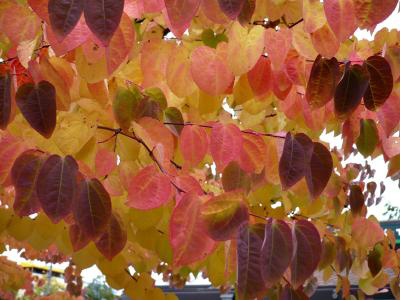
From the blog: "Most of all, however, I love the smell of the senescing leaves. For some reason, as the leaves of Cercidiphyllum start to break down, they become intensely aromatic. Some say the aroma is like candy-floss or strawberries. Lately, the distinctive burnt sugar fragrance suggests crème brûlée to me (perhaps I'm not getting enough expensive desserts to eat). To be honest, it really reminds me of raking katsura leaves in my childhood, ..."
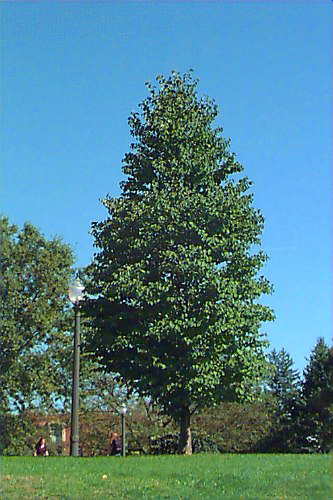
link to UConn horticulture tree page on cercidiphyllum japonicum (good details)