2. Hudson Surveys a Street
‘If
you can look into the seeds of time,
And say which grain will grow and which will not,
Speak then to me,’
Macbeth—Act I, scene iii, line 58
"It’s
actually smug, that street," complained Hudson to a mixture of tomato
juice and vodka, a disgusting drink that he sipped in hopes it would send
him back to sleep, "smug and complacent." He addressed the street
as if it might care to defend itself.
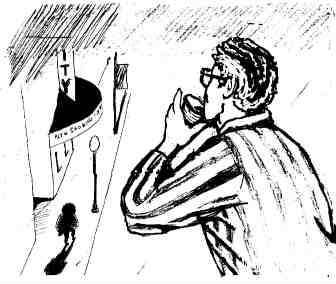
Below his eighth-story vantage point, the
deserted Main Street laid itself out for his scrutiny in quiet confidence
that it could withstand the inspection of the most critical viewer. It
was certainly not the street’s fault that Hudson’s own discontent colored
his vision of it.
For no apparent reason, Hudson had awakened
at 2:20 a.m. this morning to find only an empty street with which to converse.
The street and this strange community seemed to call to some wayward desire
within him, inviting him to delay, to linger, to await the call of a new
fate. As a result, he found himself on this particular balcony at the best
possible time to begin an Adventure; or possibly even a Misadventure.
The colorful street of the small town in
which he had halted for this short stay flaunted its casual design, rather
proud of its curvature, its cleanliness, its floral arrangements, its decorative
banners proclaiming the annual Shakespeare Festival. The marquee of the
Varsity Theater, dark now, interrupted the flow of the sidewalk below him.
Empty tables and benches adorned the front patios of silent sidewalk cafes.
No one worried that they might be stolen in this quiet city. Neon signs
in store windows added their dash of color to the night scene despite the
early hour, advertising beer and T-shirts to each other.
He rested his silk-clad philosophical bottom
against the rail of his balcony, the better to view the scene below, while
he again questioned his wisdom in acceding to the pleas of his old friend
Paul Revere Riley to stop in this curious town for no better reason than
to persuade a prodigal son to return to the fold. As for Hudson, he never
had a son, prodigal or otherwise, but the years of investing in the careful
raising of three daughters told him that his quest was futile.
One daughter invested herself in a young
man in San Francisco, and together they were attempting to corner all the
loose capital on the West Coast. The second was in New York learning to
be a corporate lawyer under the tutelage of her mother, Hudson’s ex-wife;
no doubt with the objective of garnering all the loose capital on the East
Coast. The third had taken herself off to Paris to discover who she was.
She had yet to find that out.
A nightwalker intruded itself into the scene
below, interrupting his meditation, capturing his attention.
It entered from directly beneath the hotel
marquee and its sharp heels tapped its way north, away from the hotel,
under the Varsity Theater marquee and along the empty sidewalk. The smugly
decorative street lights illuminated a figure (female, very good legs,
interesting mobility about the hips) that could have just exited the main
entrance of the Hotel Marc Antony. He adjusted his glasses on his prominent
nose, the better to study the solitary stroller.
"Not a stroller," he corrected
himself, noting the short, brittle stride of the woman. From long established
habit, Hudson began making a list:
1. Female, age indeterminate, clad in dark hose and a short, tight skirt. African-American, if the mop of black hair was a true indicator.
2. Her gait was rapid, with short steps, and an occasional skip. She would be running if her costume permitted.
3. Her upper body was partially hidden by a bulky cape or similar loose garment while her lower body was virtually exposed by the tight skirt and hose.
4. A large purse or satchel banged against her swinging hip as she hurried along the walk. She appeared to carry something large in her arms.
Hudson’s
imagination informed him that the lady was young, pretty and no lady at
all, but rather a woman of the night on her way home from a successful
evening’s business at the exclusive Hotel Marc Antony. It did not occur
to him that some might consider these imaginings to be unworthy of an appellate
court judge. If it had, he would surely have debated the notion.
He allowed his mind to continue to wander
while his eyes followed the woman’s hurried progress past the shops and
cafes to the town square, where stood the Carter Memorial Fountains. From
thence, she turned behind the little City Hall and disappeared, presumably
into the park that lined the creek that flowed through the square. She
had ignored the attractively arranged show windows.
For absolutely no good reason, Hudson felt
better, more alive for her passage. Were she a lady of the streets, what
might he have done if she had knocked on his door this night? Would he
have turned her out? That would hardly be civil. Why did she hurry so?
Through fear? Fearful of the empty street where she plied her trade? In
a small town such as this, buried high in the mountains, there should be
little to fear.
Pensively, Hudson added to his list:
5. She left the hotel at about 2:30 a.m.
Why? Why not spend the rest of the night? Was she rejected? Did she not want to be seen, or not seen leaving the hotel? Perhaps she changed her mind. Why not leave by the back door? Maybe she doesn’t know where the back exit is; if not, she can’t be much of a prostitute.
6. She walks like a young person, unused to high heels.
Maybe
she is underage? In disguise?
Unaware of how close to the truth his guesses had led him, Hudson was about
to abandon his vigil and once again seek surcease in the arms of Morpheus
when a second nightwalker exited the Marc Antony. It was a man, and therefore
of lesser interest, except that he followed the route of the girl, to disappear
into the City Park while Hudson watched silently, starting a second, parallel
list:
1. He walked with the long steps of a man in a hurry.
2. A dark overcoat or cape obscured his clothing.
3. A large, floppy hat concealed his head and features.
4. He followed the same route taken by the woman.
"What
is he doing?" Hudson complained to the street, "he is complicating
my plot." What plot? Was he so sunk into the doings of miscreants
that he now saw plots in everyday occurrences? Surely this was mere accident,
mere chance that sent two nightwalkers rushing from under his balcony into
the town’s park. Surely the one would not be fleeing from the other. Surely
one would not be pursuing the other. Surely.
He stared at the once more empty street.
"Curious," he advised the street,
"very curious."
Why had he awakened at this time in this place, to witness two nightwalkers?
The silent street held no answer for him, nor apparently any further entertainment.
He returned to the sanctuary of his bedroom to survey the large, empty
bed, cold by now. He surrendered himself and his silk pajamas to the relative
comfort of the huge empty bed, convinced he would sleep no more this night.
No sooner had he decided to await the coming of dawn than he fell into
sleep.
He dreamed of a dozen witches dancing around
a cauldron that bubbled and chuckled as it boiled its disgusting contents.
All the witches danced with abandon. All the witches were nubile and naked.
Judge Harold J. Hudson reveled with them most imprudently.

Chapter Three

