Groundwater, Inherently
Invisible, is Disappearing
By H.R. Downs
A hundred years ago, or so, a well was a giant hole in the ground. People easily
could look down their well and see the water level. When summer came they
easily could see the level drop. If a drought hit, they knew that groundwater
supplies were in trouble because the level dropped even farther.
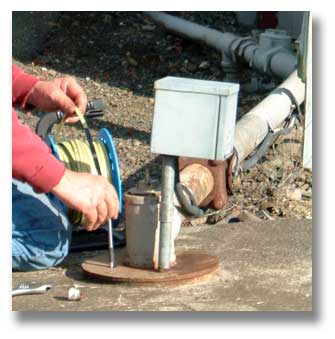
Today a well is a high-tech
piece of machinery that is completely enclosed. Nobody
can look down a modern well and if the groundwater level
drops, most people are completely ignorant of the fact.
Groundwater has become invisible to the average person.
Unfortunately, what you can’t see can still hurt
you.
That sinking feeling
The entire Santa Rosa subbasin,
one of most “water rich” areas of Sonoma County,
is in serious groundwater overdraft. “Overdraft” means
the levels have dropped and the rain and underground intrusions
can’t bring the levels back up to normal. According
to Rohnert Park’s own 1999 hydrologic study published
in a 2000 EIR, the water table under Rohnert Park has dropped
150 feet in just the last couple of decades. Unpublished
Rohnert Park city records demanded by the Open space, Water
resource protection and Land use (O.W.L.) Foundation reveal
that when the city’s entire well field is in full
throttle, the water table can dive more than 300 feet.
All over the county, people report dry wells and an increasing
number are forced to truck water because they found no
water at any depth. The O.W.L. Foundation has obtained
written testimony from hundreds of people with groundwater
problems. Both the PES
Environmental study and studies conducted by the Kleinfelder Geotechnical
Engineering Company show widespread groundwater problems
in Sonoma County.
Groundwater management a must
The Friends of the Eel River
recently won an appeal against the Sonoma County Water
Agency (SCWA) that will reduce diversions from the Eel
River to the Russian River by up to 80 percent. Virtually
every city in the county has counted Eel River water in
their expansionist general plans. These general plans,
all of them, are now based on erroneous data. There is
no longer a secure water source.
In an August 11, 2003 letter
from SCWA General Manager Randy Poole to “All Contractors,
Customers, and Water Diverters under Agency Rights”,
Mr. Poole says in part:
“ The Sonoma County Water Agency's state water rights permits limit the
Agency's Russian River diversions and rediversions to 75,000 acre feet per year.
The Agency's Water Supply and Transmission System Project ("WSTSP")
had contemplated an increase in diversions and rediversions to 101,000 afy. However,
with the Court of Appeal decision in the Friends of the Eel River litigation,
the Agency cannot implement the WSTSP at this time. Thus, it would be inappropriate
for water suppliers relying on water diverted under the Agency's water rights
to anticipate water deliveries based upon diversions of 101,000 afy . .
.”[emphasis added]
Many cities had been banking
on this one-third increase in water and had projected their
growth based on it. But now, instead of growing by a third,
cities will have to cut back on building projects and start
fitting into a very tight water budget.
As diversions from the Eel
River dwindle, more groundwater will be sucked out of the
ground, and we already know that groundwater is disappearing
(cf. PES Environmental and Kleinfelder studies, etc.).
Nevertheless, Mr. Poole says:
“ The Agency's water supply facilities include five collector wells and
seven conventional wells along the Russian River near Forestville. A sixth collector
well is under construction and should be completed in the summer of 2004. In
addition, the Agency operates three wells in the Santa Rosa Plain to augment
production capacity of the Russian River water supply facilities.” Surely
they’ll appeal?
Keen observers have speculated
that SCWA will appeal the appeal, and they may. But the
court’s decision against SCWA focused on a flawed
EIR. Further appeal will cost dearly and take considerable
time. The EIR in question, when printed out and placed
on a table, has a physical length measured in feet! When
SCWA lawyers estimated at a September 8 Water Advisory
Committee (WAC) meeting that it would take at least a year
to fix, WAC Chairman Miles Ferris, said that would be “Warp
speed.” No one had any idea at this meeting what
the timetable might be. The only sure thing is that we
are looking at very tight water supplies for at least a
year, but it could be considerably longer.
Despite clear warnings that
our groundwater aquifer is in peril and that a major supply
of water from the Eel River will dry up, Sonoma County’s
Supervisors and the County’s cities continue to permit
growth with scant regard to water supply. But now even
SCWA General Manager Randy Poole is saying what the O.W.L.
Foundation and Penngrove residents have been saying for
years: We have no more water for unbridled growth.
Sonoma County needs
a plan
Sonoma County has no groundwater
management plan, in other words no one is minding the store.
This year millions of dollars in Prop 13 Groundwater Recharge
and Storage Construction grants were offered to local governmental
agencies, including the Sonoma County Water Agency, all
of the cities in Sonoma County, and to the County government
itself. The State received 43 grant requests. No requests
came from Sonoma County.
The Department of Water
Resources (DWR) stipulates that local agencies are responsible
for formulating groundwater management plans. DWR has specifically,
and repeatedly, warned of the dangers to groundwater overdraft
in the Santa Rosa Plain. One warning was spelled out in
1982 in a document known as DWR 118-4 1982. SCWA never
bothered to establish monitoring wells; no plan was ever
developed, and, not surprisingly, as Rohnert Park’s
hydrologic study discovered, the area is in serious overdraft.
In fact, Sonoma County is
on record with DWR as having “no interest” in
forming a groundwater management plan. Other agencies expressing “no
interest” either have no groundwater at all or have
small populations located in remote areas. Sonoma County
stands out as a generally water rich area whose custodians
have “no interest” in managing it.
Consider this passage from “Groundwater
Management in California: A Report to the Legislature Pursuant
to Senate Bill 1245 (1997), 1999”:
Sections 10750-10756 of
the California Water Code (AB 3030, Chapter 947, Statutes
of 1992 and amendments) provide a systematic procedure
for an existing local agency to develop a groundwater management
plan. These sections of the Water Code provide such an
agency with the powers of a water replenishment district
to raise revenue to pay for facilities to manage the basin
(extraction, recharge, conveyance, and quality). One
hundred and forty-nine agencies have adopted groundwater
management plans in accordance with AB 3030. Other agencies
have begun the process. [Emphasis added]
But not Sonoma County’s
water agency, why?
This apparent apathy may
not be as mysterious as it first seems. Since the entire
County suffers varying degrees of water paucity, admitting
a problem would slow growth. On August 11, the Water Agency
itself admitted that water supplies will dry up and that
the cities better learn to adjust. For decades, building
has been a sacred cash cow in this county but all that
is about to end.
Overdevelopment and its discontents
County government has permitted
so many new construction projects that the resulting over
population produces human waste in staggering quantities.
The effluent is recycled into what officials euphemistically
call “treated wastewater.” Treated wastewater
doesn’t mean that this water is drinkable; it is
still the consequences of human waste. Even grape growers
will not use it after fruit has appeared on the vine. And
no one knows the long-term effects of wastewater on underground
aquifers. Yet because of growing water scarcity, and a
burgeoning thirsty population, “treated wastewater” is
being foisted on us in increasing quantities.
We are about to see a host
of water-saving techniques in addition to wastewater use.
All the familiar drought techniques will return; the brick
in the toilet reservoir, low flow everything, shower with
a friend, you name it, but this time we will be forced
to adopt such measures without a drought. We could be headed
for big trouble if we don’t quickly implement a groundwater
management plan. Something will eventually give if our
precious water resources continue to dry up, and the population
continues to surge. In other parts of the world, this “something” is
called a “water war”.
H.R. Downs is President of the O.W.L. Foundation, a grassroots, non-profit
organization dedicated to open space, water resource protection and land
use.