


|
|
||
|
|
|
|
|
Chapter 02 - An Addition to the Family; Time to Move |
4 |
||
|
|
|
|
|
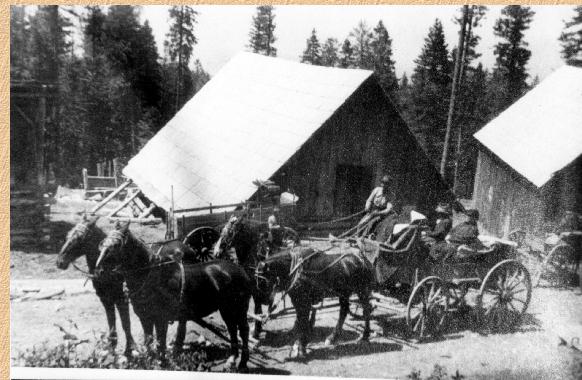
At the time of this narrative, of course, the wagon road had been scratched out of the wilderness, and a "regular" stage schedule was in operation from Grangeville or Stites, (which soon became the nearest rail road terminal) to Elk City. The word "regular" is used advisedly, as the schedule was met only a few weeks in the summer when the mud and ruts had partially dried out; or, in midwinter when the snow roads were "broken in", and new snows did not obstruct passage. Stations were established along the way, equipped to accommodate the passengers, drivers and horses, in the rather crude manner of the day. These stations consisted largely of log buildings, and included bunk - house, boarding house, where excellent meals were invariably served; log barns for storage of a winter supply of hay, and stables for the many horses required. There were three principal stopping places along the route leading to Elk City: Switchback, Mountain House and Newsome House. Going into the mountains Switchback was the first station, located some fifteen miles from the starting point. To this point the way was practically all up hill, and the name Switchback apparently came from some of the hair-pin bends graded out to accomplish the up hill pull. Switchback was primarily a nooning station where the horses were rested and fed, and replaced if necessary, and the stage drivers and passengers had dinner. It also had over night accommodations for emergencies and for freighters who were on a slower schedule. |
|
|
|
 |
||
|
|
|
|
||
|
|
|
|
Mountain House, the next station to the east was about 9 or 10 miles further up the grade. It was located on Old Baldy, the highest elevation on the road. Old Baldy was a desolate area near timber line, and was not far from the 7128 foot peak called Pilot Knob. It received the heaviest snows along the route and, being less timbered, caught more of the winds and drifts. Mountain House was not a scheduled stop for the stages, but it caught much of the trade from freighters with their four and six horse teams, and also much emergency trade from the stages. It was equipped like the other stations with log bunk house, boarding house and stables. The third main stage station to the east some 9 or 10 miles, most of it down hill was Newsome House. This was located in a small meadow land on a clear mountain stream called Newsome Creek. Newsome House had the usual large barn and stable structures made of logs and rough lumber, and capable of bedding down over night 15 to 30 horses, if the need arose. It also had one large log building with kitchen and dining area on the ground floor, and an attic with rows of bunks for the stage drivers, freighters and single male passengers. There were three or four small log cabins, some single room, some two room for married couples, ladies or the more elite passengers. From this station it was only about eighteen miles to Elk City. The stage schedules were set up to cover the journey of approximately 52 miles in one and one-half days with the overnight stop at Newsome House. The long end of the journey from Stites to Newsome was covered by two stages, one traveling each way every day, and meeting at Switchback at about noon for dinner. The short end of the trip from Newsome to Elk City was covered by one stage, from Newsome to Elk for dinner, and back to Newsome each night. In passing, and in light of today's costs, it may be said that the passengers really got their money's worth. The stage fare for the day and one half journey was eight dollars, including baggage. The meals, though fundamental, were excellent, and were served "American style", in large platters and serving dishes, -all one could eat for 50 cents. Bunks were .50 cents, and the more private sleeping accommodations were $1.00. When stages are mentioned, the popular conception is usually that of the Concord type coach with four of six horses. Concord stages were tried, in fact, were actually used at times on the Stites - Elk City stage route. But they were found to be too bulky and un-wieldy or the crooked, rutted, steep and hilly roads which had evolved from the original trails. So a "stage body" which could be adapted to a heavy Studebaker wagon or placed on a set of sleigh runners was adopted. This was a standard wagon body, but with a high front seat for the driver, allowing a large compartment or "boot" below his feet. This "boot" carried the mail, express, baggage etc., and in inclement weather was covered with a heavy tarp brought up over the high front seat like a lap-robe. The rear or main body of the wagon bed was furnished with one, two or three spring seats as the occasion required, for two, four or six passengers, and there was always room for one with the driver. There was no overhead covering regardless of the weather. For cold, snowy or rainy weather, passengers were furnished only with a canvas lap - robe. |
|
|
|
 |
 |
||
|
|
|
|