|
In cold winter weather, occasionally getting down to 10 or 20 degrees below zero, passengers sometimes took along coke foot warmers, or hot water bottles or hot rocks. Frequently, passengers not provided with such equipment walked about as much as they rode in order to keep warm. Drivers were usually pretty well prepared with layers of thick clothing with suitable footwear. In rainy or snowy weather, the passengers either provided themselves with rain wear and umbrellas or got soaked.
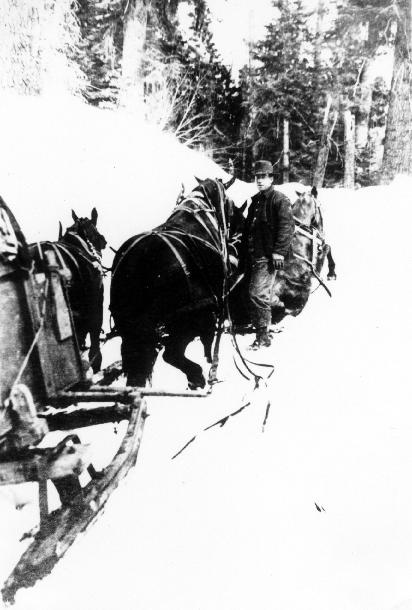
Heavy winter snows presented the worst obstacles to keeping schedules. The first snows of the season were usually taken in stride, with wagons being used until enough snow covered the ground to accommodate the sleighs. But later in the winter, when overnight storms might deposit and drift several feet of the fluffy stuff over the old tracks, progress became very difficult. The horses would flounder, get off the beaten track and become entangled in the harness. Sometimes the driver and passengers would wade ahead for short distances, tramping paths for the horses. Horse snow shoes were also employed in some instances. These were wooden pads about 14 inches square and 2 inches thick. They were provided with holes into which the calks of the horses iron shoes would fit, and a curved iron strap which bolted around the toe of the horses hoof. Horses had to be trained in the use of these pads, but once a snowy road had been traversed with them, the road would be "broken" so that the horse snow-shoes could be dispensed with.
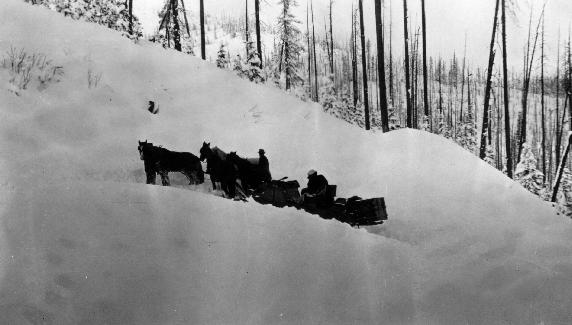
So much for the background of the old road and it's accommodations. The Strongs and Argetsingers were probably only partially aware of what was ahead for them, but, once on the way, there was no turning back. As mentioned before, it had been a bad winter, and the snow was deep and menacingly drifted over the roads. A few details of the trip were frequently recalled by some of those participating in the journey. The first long day got them past Switchback all right, but only as far as Mountain House. At this point the snow was thirteen feet deep, and there was little evidence of the station buildings except parts of the roof and tall stove-pipes emitting wisps of blue smoke. Steps were cut in the ice and snow to get down to the floor level of the houses, and sloping ramps led into the stables, where the horses were reasonably comfortable. Just what sleeping accommodations were provided, and just how comfortably the young couple with the three-months-old baby spent the night was never revealed in detail.
During that night considerable more snow fell and drifted across the road right-of-way. The next morning, as the four horse team with its loaded sleigh slowly crept around the precipitous slopes of Old Baldy, only the high blazes on the trees and the stage drivers intuition and knowledge of the terrain served to keep them on the proper course. In some places, where the narrow road had been graded around steep mountain sides, snow drifts had filled the excavations, leaving the curvature of the mountain sides appear unscratched. This, of course, caused the sleigh to tip precariously toward the down hill side. In fact, to prevent the stage from turning over and dragging the whole outfit down the mountain side, two men rode standing on the up-side sleigh runners. And, in order to free the mother's hands so that she might hang on to the seat at such an angle, the men held the baby in their arms as they rode on the sleigh runners. Under such conditions progress was miserably slow, and it was devastatingly cold. In places the lead horses would be breast deep in soft snow, and if their hooves, on penetrating the new layers of snow, did not meet the previously broken paths, they would sink through, flounder and thrash until calmed and gotten to their feet by the driver. |
|