


|
|
||
|
|
|
|
|
Chapter 03 - Arrival in Elk City |
6 |
||
|
|
|
|
|
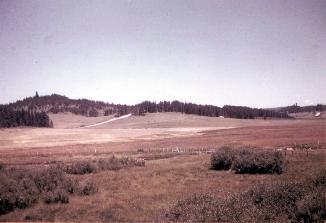
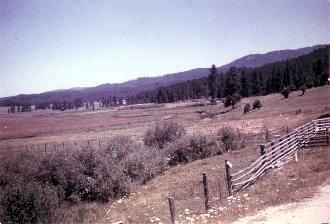
The "Elk City Basin" , as it was called, was a beautiful mountain vale or valley, the likes of which were infrequently encountered in the forested mountainous areas of the North-West. curving meadowland stretched in a generally northerly direction some two or three miles, with a width varying from a quarter mile to a mile or more. Along its edges the green meadows faded into small jack-pine timber, and on beyond, an all sides, these lighter green trees seemed to merge with the larger darker green forests as they billowed over the hills to the blue base of the higher mountains in the distance. Through the meadow, on a zig - zag course frequently altered by beaver and muskrat, flowed the little trout filled stream, Elk Creek. To the north could be seen the rather round, bald top of Anderson Butte. To the west and somewhat north stretched a long blue tinged ridge of the Iron Mountains. And to the south, from some view points, the heights of the "Buffalo Hump Country" were visible. In all other directions, more distant views were hidden by forests. |
|
|
|
 |
||||
|
It had been a beautiful mountain vale or valley, the likes of which infrequently encountered, - - - - |
||||
|
|
|
|
|
 |
||||
|
Along its green, grassy meadows the colors faded into the darker shades of the bordering jack pine forests. |
||||
|
|
|
|
|
|
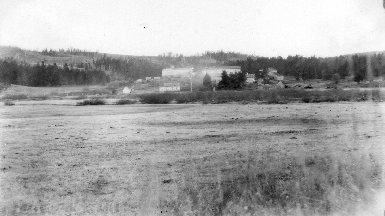
At the southern end of this meadowland, extending eastward like two stubby fingers, were two small tributary meadows. And between these two lowlands was a gently sloping ridge or "hog - back" leading on eastward and upward into the forests and mountains toward the Bitterroot Range. This hog - back made a natural grade for the establishment of the original trails and the subsequent wagon road. It is therefore a logical supposition that on this little ridge the first camps and tents and cabins were developed. It was dry land, yet near enough to water. |
|
|
|
 |
||||
|
The little mining camp was located on a small ridge, or "hog - back", with a little meadow on either side. |
||||
|
|
|
|
|
|
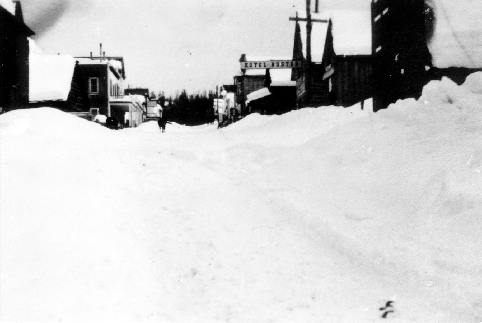
In any event, this became the main street of Elk City. The top of the ridge was rounding, and wide enough for the street, but the buildings facing it, - if they extended back any distance, had to be supported at the rear by stilts, or log posts of varying lengths. Pine logs, being about the cheapest commodity available, were used extensively in building. Their only cost was in the felling, trimming and dragging them to the site of construction. All buildings, whether lumber or log, had pine log foundations, usually hewn to shape only enough to support the structure contemplated. |
|
|
|
 |
||
|
|
|
|
In winter it could be all but buried in snow drifts. |
||
|
|
|
 |
 |
||
|
|
|
|
