


|
|
||
|
|
|
|
|
Chapter 04 - A Place to Live; About Town |
10 |
||
|
|
|
|
|
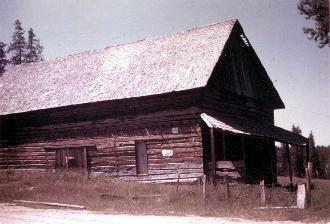
And then there were the china houses, and a particular experience never quite erased from the boy's memory. While mother was down town shopping, she stopped on the street to converse with an acquaintance. The small fry ambled on a few yards to a one room cabin occupied by six or more Chinese. It was a bright warm day, and the cabin door was open, so the boy walked right on in. On either side of the room were tiers of three bunks, one above the other. Puttering around a stove and table were two or three Chinaman with their long black queues hanging to the waist or wrapped turban fashion around the head. On A lower bunk lay a Chinaman fast asleep; on the other lower bunk, another was indulging in an opium smoke. On the stool beside him was a lighted candle, the peculiar looking pipe, and the can of opium, plus such other implements as were required in the process. No one paid any attention to junior until his mother jerked him out by the arm, when the Chinese acknowledged the situation with an indifferent nod and grin. In those days there were no laws against the importation and use of opium by the orientals; many of them used it, and the whites were indifferent to the, Chinaman's habits. In the late summer an occasional "peddler" would arrive in town to the great delight of housewives, whose cooking staples most of the year consisted largely of dried foods or canned foods, though potatoes, onions and bacon seemed always available. The short summer season of the mountains, with occasional frosts occurring in July or even August prevented all fruit and most vegetable culture. Sometimes limited success was attained in raising rutabagas, turnips, radishes and leaf lettuce, but little else. But "outside", in the lower elevations and milder climates along the Clearwater River, the small farmer raised good fruit and vegetable crops. So he would fill a wagon bed with his surplus produce, cover it with a layer or straw and a tarp to protect it against a possible mountain frost or the penetrating sun, and head for the mining camp. There, the people, unaccustomed to the odors and tastes of fresh fruits and melons and vegetables, would soon buy out the "peddler.". Always remaining with the youngster were misty recollections of the dances or hoe - downs which were held periodically, usually on holidays, but occasionally inspired by some one's sudden notion. These dances were ordinarily organized on the spur of the moment by the simple expedient of some one suggesting to a group in conversation, 11 Let's have a dance if we can get a fiddler" There were two fiddlers in town, one being Mr. Crunk, a rather crusty cranky, moody old sourdough, who usually played hard to get when approached, but who always seemed happy while he fiddled four of five hours. And he always seemed especially pleased when the hat was passed to pay him and the organ chorder who accompanied him. Each man at the affair would chip in about fifty cents. Then there was Eric Jensen, a little Scandinavian, with a high pitched voice who also required some coaxing to induce him to play a dance. His strangest characteristic was that he held the violin between his knees rather than under his chin while he fiddled. These dances were the only public community social gatherings of the settlement. No invitations or bids were sent. The word was simply passed along, and every one who danced, came. The dance hall was a large log building half way between "down town" and "on the hill". It was particularly well constructed of hewn logs, with high walls and gables and sturdy shake roof. A small portion of the west end was partitioned off for a "refreshment room", and was furnished with long plank tables and rough board benches. This room was capable of accommodating possibly thirty to forty persons at one time. The dance floor was made of common pine lumber, not tongue and groove.- but closely matched, and evidently planed and sanded smooth by hand. Long wooden benches lined both sides of the room, and a stove with a supply of pine wood filled one corner. Light was furnished by kerosene wick lamps with disk mirror reflectors, one on each wall. Parenthetically it may be noted that this old dance hall was a sort of mystery building. When was the big log structure erected and for what purpose? Could it have been a lodging house originally? By whom was it constructed, and under what circumstance was it conceived and financed? On whose property or lots was it situated? If anyone knew the answers to these questions, it was never mentioned or discussed. No one cared. It was just there, - for public use. The custodian seemed to be the person who happened to leave the party last, locked the door and took the key home. It was abandoned about 1907 when a better dance hall (Belore's I.O.O.F. Hall) was constructed "down town", and it remained vacant for years. Later, a nearby resident, "Coyote Bill" Harris assumed possession of it, converted the "banquet room" portion into a cow barn, and stored hay on the former dance floor. It stands today (1956) a log monument, unmarked, unused, defying the winter snows, and is apparently an un-noticed mysterious enigma to the current sparse population. |
|
|
|
|
THE DANCE HALL |
||
|
|
|
 |
||
|
|
|
|
As it appeared approximately 50 years after the last dance had been held there. It had been the scene of the annual community Christmas celebrations. Here, also, the later deposed German clergyman held some of the few church and Sunday school meetings of the early days. It was likewise used on occasion as a "theater" by roving bands of "minstrel" entertainers. (Note the hand hewn log construction. Entrance door (center - left) had been replaced by sliding barn door; horse and cow shelter had been added (right).) (Photo 1956. Building is now demolished.) |
||
|
|
|
|
Families attending the dances brought all the children; there were no baby sitters, Smaller infants were bundled in blankets and put to sleep on the benches near the stove. Older children skipped around the floor or sat on the benches until the monotonous beat and drone of the organ and fiddle lulled them into stupefaction, when they too, were put to bed on a bench. Before the dance started, one or two men would circulate around the floor with miners' candles and jack - Knives, scraping fine shavings off the candles for floor wax. The caller would announce each dance, whether waltz, two - step, schottische or quadrille, and then the men would dash to the benches . There the ladies were always seated, and choose their partners. There was always a large stag line by the door, some of them young - men who came all dressed up to dance, but most of them were old miners and sour - doughs who just came to look on. The dance usually ended about midnight or one o' clock, after which a big pot luck feast would be held in the refreshment room. |
|
|
|
 |
 |
||
|
|
|
|