


|
|
||
|
|
|
|
|
Chapter 04 - A Place to Live; About Town |
11 |
||
|
|
|
|
|
There were occasions, though rare when Daisy and Lee would take a day for fishing or huckleberrying. The destination was usually several miles away by trail, so horseback was the mode of travel. Daisy rode a side - saddle, as did most ladies of that time. Actually, in some areas and in some circles, it was considered quite un lady like to ride astride. She wore a long divided riding skirt so long, in fact, that the folds of cloth had to be carried by hand until she was mounted on the horse. This long riding skirt was discarded for a shorter divided skirt worn beneath it when the horses were staked out and the fishing or other activities were to begin. The side saddle was a weird but comfortable contraption, with a pan shaped padded seat and a two -forked horn in front and on the right side. The rider's right foot rested in the single stirrup, with the right knee fitting snugly under one fork of the curved horn. The left knee was hung over the other fork of the horn with the left foot dangling loosely over the horse's right shoulder. When Junior went on these excursions, he rode in front on the "lap" of of the riders. When he became burdensome to one, the horses were pulled over closely side by side, and he would be passed over to the other rider for a while. One of these fishing trips in particular left a lasting impression on the boy, who was apparently too young to fish, but old enough to follow. It was a very small but productive trout stream. The horses had been tied up where the trail crossed the stream, and fishing progressed leisurely up the creek. About mid - afternoon the creels being adequately filled and the fishermen being sufficiently tired, it was time to return to the horses, and toward home. But instead of following back down the brushy creek bottom, it was deemed easier to follow the path of an old placer ditch which followed on grade along the open hill sides west of -the stream. On the hillsides opposite, and across the stream, was an extensive area of heavy dead - fall. The term "dead - fall", as used by mountain people, had two definitions; one being an animal trap utilizing heavy objects such as logs or Doles weighted with rocks, and designed to crush an animal caught in it. The other definition referred to a forested area, which a decade or two previously had been killed by a. forest fire. The dead tree trunks will stand for years, the wood becoming dry and sound and solid, as if defying the elements to bring them to earth. But eventually the roots will rot in the soil, and one by one, the valiant sentinels will begin falling in all directions, one across tossed on the other, like a handful of parlor matches carelessly tossed on a table. A heavy dead fall area is difficult country to pass over unless one has good balance for walking logs and hopping from one log to another. In fact, In some such areas one may travel some distances without being closer to the ground than three to six feet. All this, in turn, is further complicated by the young trees and underbrush which may have grown up subsequent to the fire. Such a dead - fall covered the mountain sides opposite the fishermen. But it probably would have escaped their attention if they had not heard a loud crackling in the brush, and, looking up, saw a big brown bear in the midst of it. He had apparently been browsing on huckleberries in the bushes, and on hearing voices, became panicky in his efforts to find an exit. A bear is not considered to be too I graceful under any circumstances, but this animal's movements, as he tried to scramble up hill over the hundreds of criss - crossed fallen logs, were outright ludicrous. Then, to speed the action, Lee hooted at him through cupped hands at the top of his voice, until the frightened beast tumbled out of sight beyond the first hill rise. That fishing trip was a subject for conversation for many days. Members of the populace were, of course, plagued by the usual illnesses and injuries, and they used such remedies as were probably prevalent most everywhere at the time. A sore throat generally called for a teaspoon of sugar with several drops of kerosene (coal oil, as it was then called) Cuts, scratches and bruises were treated with liberal doses of turpentine. Epsom salts was the ultimate prescription for any one feeling a bit sluggish or not just right. But Elk City also had a Doctor in those early days, a Doctor C.C.Cullen. Dr. Cullen was a large amiable, gentle man with a full face and a large mustache. Given the suitable glasses and toothy grin, he might have doubled for Teddy Roosevelt. His patients seemed to consider him competent and trustworthy, and not lacking in bed - side manners. But Dr. Cullen had one failing: at periodic intervals, perhaps three or four times a year, he would "get full", or "go on a toot", sometimes lasting several days. During these occasions he would not be available to any patient under any circumstances. At first it seemed that the people thought little of it; in fact, admiration was sometimes expressed that he would practice his profession only in his most sober moments. But, as time went on, his periods of unavailability became more frequent and lasted longer, and it finally became obvious that the citizens would have to seek other means of providing for their medical care. The population was not large enough to support an up-to-date Doctor just by cases and calls alone. So a subscription list was circulated asking families and individuals to sign up for some stated amount each month. A business man might sign for $5.00 per month, a family $3.00 per month, and a miner or teamster one or two dollars per month, as each ones means permitted. Thus a steady income could be offered a Dr. to make his residence in the town, and his services would be available to every one. Dr. Davis was one of the first to serve the citizenry under this system, but after a time the contributions dwindled, collections became difficult, and Dr. Davis departed. Later a Dr. Yates came to minister to the people under the same system, and he remained a resident for some time. After the introduction of this system and the arrival of a new Doctor, Dr Cullen's practice fell to practically nothing. He appeared to become resentful and sullen, and his propensity for strong drink kept him continuously unavailable until his death. Such had been the atmosphere, the mode of living, the small experiences of a small boy growing up in a tiny log cabin in a little isolated mining town. - But the log cabin days were to end as abruptly as they had started, and a new mode of life was in store. The partnership of Argetsinger and Strong had not lasted too long, probably because it could not initially properly support two families. In any event, Strong had bought out Argetsinger, and the latter had returned to the "outside". Through the years from the late 1890's to 1905 mining excitement had been increasing and new strikes were being reported; some of the larger placer diggings were being worked' with big hydraulic "giants"; prospectors were scouring the hills for new ledges, and the Strongs' business was prospering. Indicative of the general prosperity was the fact that in 1905 a sizable group of businessmen, the butcher, the stable owner, hotel keepers, saloon men and store owners chartered some special stages to the rail terminal at Stites, and, with their families, had a hilarious excursion of two or three weeks to the great World's Fair at Portland. |
|
|
|
 |
||
|
|
|
|
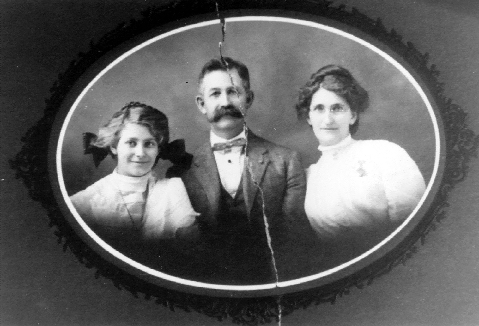
Argetsinger Family. Having sold his share of the partnership business to Strong, Argetsinger moved to Arizona. Photo mailed from there about 1907. |
||
|
|
|
 |
 |
||
|
|
|
|