|
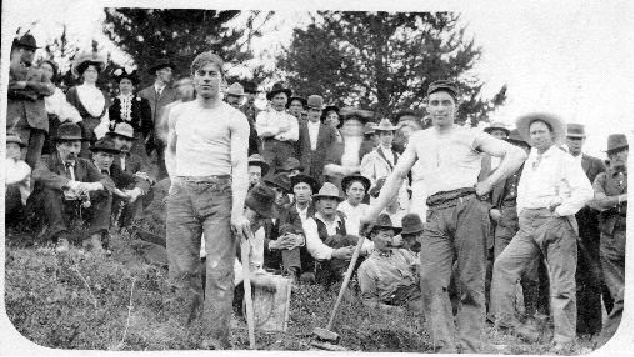
The hard rock drilling contests with hand tools, being so far removed from modern machines and methods, might bear a brief description. Two teams, each consisting of two drillers and a handler competed for the honors. Their objective was the greatest number of feet and inches drilled through hard rock in a timed period of ten to fifteen minutes Each team was supplied with two double-jacks and a set of newly sharpened drills graduated in length from a foot or so to four or five feet. (A double-Jack is a heavy long handled sledge requiring the use of both hands, as distinguished from a single-Jack which is a lighter, short handled sledge for use by a single driller. Hard rock were often referred to as "good double-jackers", or "fair single-jackers", as the case might be). The "handler" managed a five gallon can of water, equipped with a hose, and he played a small stream of water into the drill hole to carry away the drill cuttings, keeping the drills from sticking. The drills were neatly laid out so that each progressively longer drill would be readily available.
Each team had its partisan adherents, and the rooting, and the feelings, and the betting sometimes became quite extensive. When the starting gong rang, the number 1 man would hold the shortest drill to the rock, rotating it a partial turn between strokes, while the number 2 man began striking the drill head strongly and rapidly. As the drill sank slowly into the rock, the team would soon be splattered with mud, drill cuttings and water. This continued until the hold was deep enough to hold the short drill in an upright position, when the No. 1 man would grab his double jack and begin striking the drill head, alternating his strokes with those of the No. 2 man. Having picked up the cadence of the stroke, the No. 1 man would continue striking while No. 2 held and turned the drill, thus giving him momentary relief. When a longer drill was needed, the short drill was thrown out of the hole and the next longer one was inserted between strokes with such alacrity that the cadence of the striker was never altered. It can be imagined what a problem this presented when the four or five foot drills were required, and the crowd was cautioned to stand away from the flying drills. Thus the ordeal continued to the final gong, the holder relieving the striker on-signal., never losing the cadence of the stroke, and getting in several extra double licks while changing positions. It required skill and endurance. A miss of the drill head could crush the holder's hands, and as for endurance; one muscular 190 pound blacksmith miner, well accustomed to hard physical labor was observed to fall in a dead faint from sheer exhaustion when the gong sounded the finish of his turn. |
|