Will the capo's bend match the radius of my fretboard?
YES it will. How can we be sure that the bend of the model 1 will match your fretboard? Because the sleeve material of the Shubb capo is engineered to be ultra resilient, so it will conform to a range of fretboard radii. This extraordinary resilience enables the rubber material to cushion the strings while pushing back on them ... just as your fingertip does.
The result: the strings are held snugly against the fret, so they won't buzz. And they are not stretched over the fret, so they won't go sharp.
Tweet
Years ago, when the Shubb Capo was relatively new on the market, I wanted to be sure that its design was as universal as possible, so I set out to really get precise about this.
At a NAMM (music trade) show I spent hours with the manufacturers of many of the most common guitars on the market: Martin, Taylor, Santa Cruz, Collings, Gibson, Fender, Takamine, and some others. In most cases I was given the actual specs to which their fretboards were made, and then double-checked by measuring them with a contour gauge. I spent more than two full days documenting those fretboard radii, with all the necessary resources within a few hundred feet.
My conclusion: we were already solidly in specs for ALL of them. Here's why:
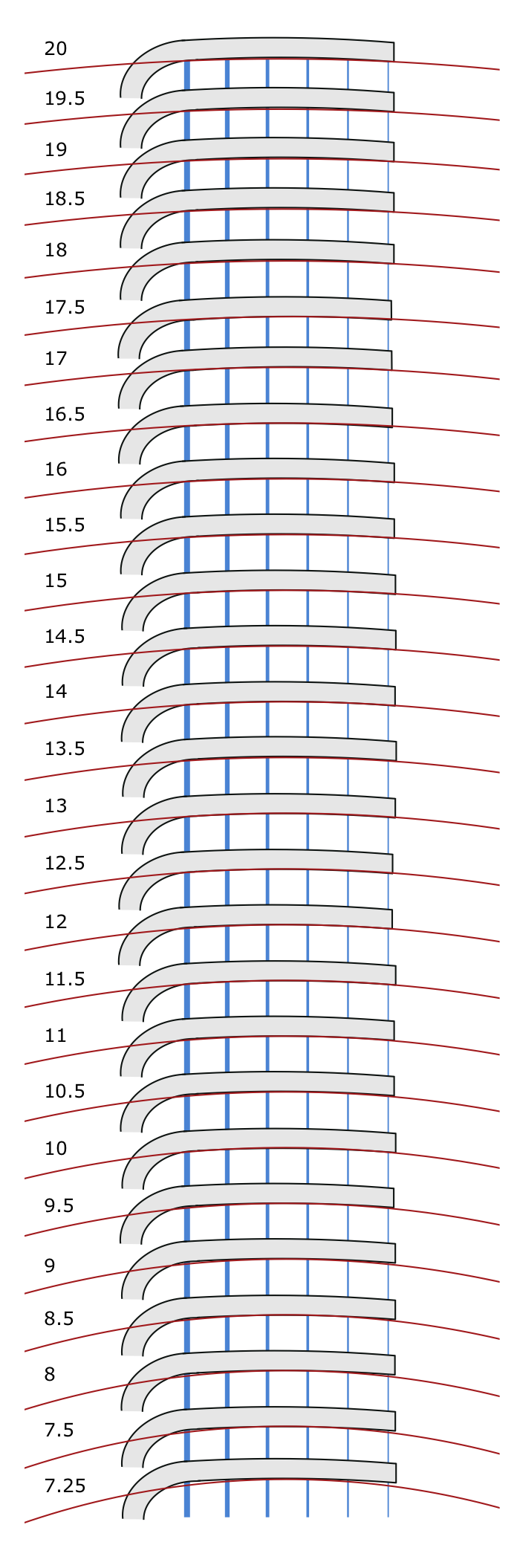
• The differences between the entire range of radii used by guitar manufacturers -- across a two inch span -- is almost imperceptible, both to the eye and to the functioning of the capo. When I pressed the capo against any of these fretboards, from the largest to smallest radius, the capo's curve appeared to be perfect. And the functioning of the capo confirmed it.
The chart to the right illustrates how slight the difference is across the range of radii used on fretboards. The same drawing of the capo's curve, compared to radii in half inch increments, ranging all the way down to 7.25" ...for which we do make a special model.
• The resilience of the Shubb Capo's rubber material is sufficient to adapt it to a wide range of radii or even compound radii — so much so that at least one professional I know (John McEuen) uses only one capo onstage (a Shubb S1 guitar capo) on all of his many instruments, some with radius and some with flat fretboards. And he is a very discerning musician.
And if we really want to look very closely, the capo's real assignment is not resting against the fretboard, it is resting against the tops of the strings. And the difference in gauge from first to sixth makes that shape slightly different from the fretboard's radius.
BOTTOM LINE: don't worry about it. If the fretboard radius is anywhere from 8.5 " to 20" the model 1 (or 3) capo will work perfectly. That may sound like a big difference, but over the 2" span of a guitar fretboard it is virtually imperceptible.
...Rick Shubb