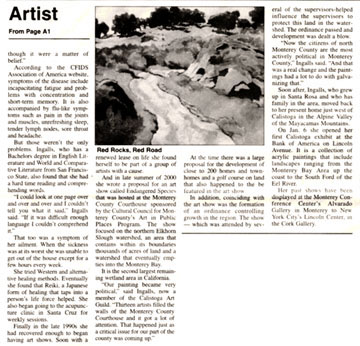
The Weekly Calistogan
Thursday, January 8, 2004


When Landscapes Come to Life:
The story of a now thriving artist

By Mike Lynch, Editor


For a large part of the 1990's, Karen Lynn Ingalls was bedridden
with a disease that has been seen as more of a myth than a
reality. But when she did finally defeat her nightmare, she rose
to the head of a conservation movement. In the process, she
reinvented her art and the land it represented.
1

It was the fall of 1993. Ingalls, 47, was working as an English
teacher at Gonzales High School in Monterey County. Suddenly
a flu-like epidemic came through the school. Students became ill
and so did she.

At first she didn't know what it was that ailed her. Doctors were
unable to diagnose her symptoms. Finally, she discovered she had
Chronic Fatigue Immune Dysfunction Syndrome, an ailment that
affects more than one million annually.
2

"Most of the people who were getting sick were farmworkers
without adequate healthcare or enough moneh to really see
many doctors, and it occurrred at a time when most doctors
didn't recognize that it existed," said Ingalls, who now lives in
Alpine Valley between Calistoga and Santa Rosa. "They talked
about it as though it were a matter of belief."

According to the CFIDS Association of America website, symptoms
of the disease include incapacitating fatigue and problems with
concentration and short-term memory. It is also accompanied by
flu-like symptoms such as paint in the joints and muscles,
unrefreshing sleep, tender lymph nodes, sore throat and
headache.

But those weren't the only problems. Ingalls, who has a
Bachelor's degree in English Literature and World and
Comparative Literature from San Francisco State, also found
that she had a hard time reading and comprehending words.

"I could look at one page over and over and over and I couldn't
tell you what it said," Ingalls said. "If it was difficult enough
anguage I couldn't comprehend it."

That too was a symptom of her ailment. When the sickness was
at its worst she was unable to get out of the house except for
a few hours every week.

She tried Western and alternative healing methods. Eventually
she found that Reiki, a Japanese form of healing that taps into
a person's life force helped. She also began going to the acupuncture clinic in Santa Cruz for weekly sessions.
3

Finally in the late 1990s she had recovered enough to begin
having art shows. Soon with a renewed lease on life she found
herself to be part of a group of artists with a cause.
4
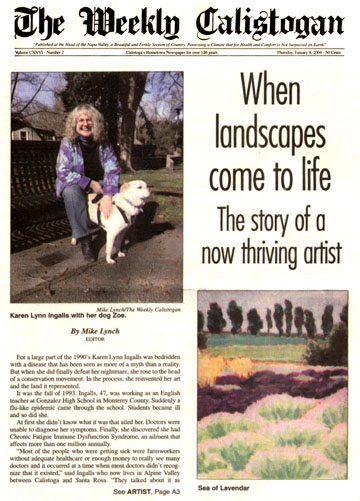


And in late summer of 2000 she wrote a proposal for an art show
called Endangered Landscapes that was hosted at the Monterey
County Courthouse, sponsored by the Cultural Council for
Monterey County's Art in Public Places Program.
5 The show
focused on the northern Elkhorn Slough watershed, and area
that contains within its boundaries thousands of acres of land
and a watershed that eventually empties into the Monterey Bay.

It is the second largest remaining wetland area in California.

Photo by Mike Lynch,
The Weekly Calistogan

"Our painting became very political," said Ingalls, now a member
of the Calistoga Art Guild. "Thirteen artists filled the walls of the
Monterey County Courthouse and it got a lot of attention. That
happened just as a critical issue for our part of the county was
coming up."

At the time there was a large proposal for the development of
close to 200 homes and townhomes and a golf course on land
that also happened to be featured in the art show.

In addition, coinciding with the art show was the formation of
an ordinance controlling growth in the region. The show - which
was attended by several of the supervisors - helped influence
the supervisors to protect this land in the watershed. The
ordinance passed and development was dealt a blow.
6

"Now the citizens of north Monterey County are the most
actively political in Monterey County," Ingalls said. "And that was
a real change and the paintings had a lot to do with galvanizing
that."

Soon after, Ingalls, who grew up in Santa Rosa and who has
family in the area, moved back to her present home just west
of Calistoga in the Alpine Valley of the Mayacamas Mountains.

On Jan. 6 she opened her first Calistoga exhibit at the Bank of
America on Lincoln Avenue. It is a collection of acrylic paintings
that include landscapes ranging from the Monterey Bay Area up
the coast to the South Fork of the Eel River.

Her past shows have been displayed at the Monterey Conference
Center's Alvarado Gallery in Monterey to New York City's Lincoln
Center, in the Cork Gallery.


Article © 2004 The Weekly Calistogan
Reproduced with permission


Corrections and Footnotes noted by the artist:

1. I worked very hard to effect some change in the area where
I lived, and was able on occasion to make a significant
difference, but I was one of many community members who did
so. I am proud to know them and to have counted myself among
their number.
Back to article

2. I was very lucky in seeing a doctor, Dr. James Daly, fairly early
on who recognized my symptoms as possibly indicating CFIDS,
among other possibilities which he then ruled out. That was not
typical of most people with CFIDS at the time.
Back to article

3. A number of alternative healing methods have assisted my
recovery process, which is ongoing. Among the most significant
are Traditional Chinese Medicine (including Chinese herbs and
acupuncture), the Jaffe-Mellor Technique, Cranio-sacral
therapy, Reiki and other forms of energy medicine, an Alpine
air purifier, and, last but not least, prayer.

I heartily recommend my gifted acupuncturist, Rebecca
Weinfeld, R.N., L.Ac., whose practice is in Santa Cruz, California,
without whom I would not be functional today.
Back to article

4. Although it would have been wonderful if recovery from CFIDS
was a quick process for me, it actually was four years from the
onset of the illness until I could gather enough energy to begin
to paint again, another year before I began to show my work,
and a continued slow process of healing from then on.
Back to
article

5. Although I suggested the venue and wrote the proposal for
the show, it began as the brainchild of Monterey County
plein air painter Bill Fenwick, with whom I organized the show.
He gathered painters - we called ourselves the Elkhorn Artists
Alliance - for a series of plein-air paintouts calling attention to
the area threatened by development beginning in 1999. The
county courthouse show was curated for the Cultural Arts
Council by Carmel artist Susan Giacometti.
Back to article

6. Unfortunately, the ordinance was only a temporary
eighteen-month long moratorium on new subdivision. The battle,
years later, is not yet won. Many dedicated citizens of North
Monterey County continue to fight protracted battles against
suburban sprawl in environmentally sensitive areas without
adequate water to sustain development. One of those
organizations is Friends, Artists, and Neighbors of Elkhorn Slough,
who can be found on the web at
www.SaveOurSlough.org .
Back to article