Blog moving!
Posted on August 2nd, 2010 — permalink
A new science blogs collective, Scientopia, is starting up today, and I will be a part of that! As such, the new location for this blog will be http://scientopia.org/blogs/galacticinteractions/.
I’ve just arrived in Squamish, BC, where I’ll be starting teaching at Quest University in less than a month. It’s going to be a very busy fall semester, but as I settle back into academia I intend to pick up the pace of the science blogging once again.
See you at the new site!
1 Comment
Posted in About the Blog |
Second Life’s greatest asset, and how it was squandered
Posted on June 13th, 2010 — permalink
Before I start, I should note that I haven’t worked for Linden Lab for more than a year now, so I’m not giving away any inside information, nor do I have any inside information. Yes, my opinions are formed partially by what I learned while I was inside Linden, but I’m writing this based on my observation as an interested outsider.
I think often the way to kill a business is to over-monetize it. I remember the 1990’s, and Web search engines. The pattern was repeated over and over again. There’d be one that was the best. They’d realize they were the best, and they’d either get sold or they’d try to monetize their business. The page would go from being relatively clean, to being a cluttered mess of ads… and the search results, being increasingly paid, would become less and less useful. So we’d all move on to another engine. That ended with Google, who had the vision not to try too soon to over-monetize their search, and who recognized when they did monetize it that they had to do it in a way that didn’t completely undermine what brought people there in the first place. If you’re doing something new and cool, you’re better off focusing on how to make it cooler than you are focusing on how to squeeze a buck out of it.
How does this apply to Linden? Many think that Linden’s best asset is their technology. It’s not. Don’t get me wrong, the technology is good; but it can be replicated. Server side, OpenSim is already well on its way to replicating (and in some ways exceeding) the server side technology of Second Life. Client side, the Second Life client is still way ahead of anything out there that’s not based on the GPL Second Life client source, but that won’t last forever; after all, there are lots of MMO clients out there, so it can be done! No, Linden’s greatest asset is its audience.
I know Philip got this. Talking to the company while I was still there (a year before I left? I don’t remember) about OpenSim and competition in general, he said that OpenSim and interoperability would only be positive for Second Life. After all, Second Life had the greatest number of residents. Even if that didn’t stay, a growing interest in and a growing usefulness of virtual worlds would only help Second Life. Alas, the company as a whole didn’t realize this. What they should have been focusing on was promoting virtual worlds. Instead, they… well, to be honest, I’m not really sure what they were focusing on, but they didn’t direct substantial effort towards promoting virtual worlds in general. And that was the mistake that, I believe, led to the massive June 9 layoffs, or what I call “Lindenmageddon”.
In 2008, a team of engineers from Second Life working together with a team from OpenSim premiered a bold and exciting experiment. From the beta grid (Aditi), users were able to take their Second Life accounts and teleport to regions running the OpenSim server. The functionality was extremely basic, but it was a concept demonstration. This was the first step to interoperability. I was only peripherally involved in this myself. As a member of the server release team (perhaps server release manager by then?), I helped the engineers working on this get some regions set up, and would warn Whump whenever we were going to do things to aditi that might interupt his operations. (I also annoyed Whump a few times when doing things on the beta grid without giving him enough warning….) But, when the experiments were happening, I joined in with other Lindens and residents to see what all the fuss was. I felt like I was walking on the moon. I remember commenting to others that we were exploring grand new worlds, taking the first (and very limited) step in what was going to be a gigantic new thing. People outside the lab were talking about the possibility of true interoperability in the main grid (the production Second Life environment) during 2009. It was all very exciting. Second Life was bursting out of its shell, and was finally providing the seed for the true global metaverse that it had always promised that it could turn into.
Alas, after that, the interoperability work coming out of Linden Lab slowed to a trickle. It didn’t stop, but outside nobody else saw anything new. Many of the engineers working on it were redirected to work on the (now defunct) “Second Life Enterprise” product. (I always personally thought that was a dead-end, but I was careful who I said that too. I was annoyed that some release people we needed for other things had time taken away working on it, and I was sad that the manager whom I loved, Josh Linden, got pulled over to it. But I was also sad to see the company working on the 3D version of Novell Networks instead of the 3D version of the Internet.) Yes, Linden still did things; Enus, at least, was working on the PyOGP stack, and Zero and Infinity were involved in standards meeting and developing the WVRAP protocol. (Incidentally, Infinity left Linden Lab a month ago, and Zero was part of the June 9 Lindenmageddon layoffs.) But there was no big effort. Out of this lack of more public progress from Linden was born Hypergrid, Crista Lopes’ working interoperability protocol between separate OpenSim grids. Hypergrid still has some things it’s lacking, but it got much farther than any implementation out of Linden.
And now concurrency (number of people online at one time) in Second Life has been sagging, and the lack of growth has caused financial distress for the lab. (I don’t have inside figures, but Tateru Nino figured out at least this much from looking at the public figures.) Yes, it’s a recession. But Linden made the mistake of having people in control who were business types, who think in terms of consumers and monetization. They didn’t get Second Life. (Truthfully, nobody does, and the first step to understanding virtual worlds is recognizing that you don’t get it. It’s a tremendously flexible potential platform. Like the Web, if you try to put it in a conceptual silo and productize it, you’re going to be making something like early 1990’s walled-garden AOL, which will fail in the face of the true Web.)
I work with MICA, the Meta-Institute of Computational Astronomy. We maintain a presence in Second Life, even though really we’d rather be working on open source servers that we control ourselves– i.e. OpenSim. There are two main reasons why we stay with Second Life. The first is that OpenSim doesn’t yet have a good Voice solution… but that will change. The second is that Second Life is where everybody is. The popular talks that I and some others give wouldn’t make sense anywhere else, because the audience isn’t there. And this is what Second Life’s greatest asset is.
If Linden Lab had focused on helping make virtual worlds take off– make them more useful by providing functionality people wanted and needed, working on interoperability so that people could take their Second Life accounts to and from software that was developed not only by Linden engineers, but by everybody– I predict they would have done a whole lot better. Their already existing audience would have given them a leg up, and would have kept them a leader or at least a major player. Yes, they would have been helping “competitors”, but by raising the profile, utility, and popularity of virtual worlds in general, they would have helped themselves.
I predict that the decline of Linden will set back the adoption of virtual worlds several years. And that may not be so bad. After all, before the Web, there was Gopher, which was never all that big. Before that, there was CompuServe, a walled garden that a lot of people used, but which became increasingly irrelevant as there was the Web. Second Life had the opportunity to be the seed for the 3D web, but instead they chose to focus on being the 3D CompuServe. As we go into the future, OpenSim, or another platform that defines its protocols, provides a working reference implementation, and supports true interoperability will form the basis of the true global metaverse. And, once we have that, and once people are able to develop cool things to run on top of it as flexibly as possible (i.e. not limited to just LSL and renting space on Linden’s servers), we’ll see the metaverse take off. As to whether or not Second Life is part of that, we can only wait and watch. It will take more vision than trying to somehow connect to current hot buzzwords (”social media”) if they really want to be a part of this. And even if they are, they may not be a meaningful part. (After all, AOL is still a part of the Internet, is it not? But with the possible exception of the AIM protocol, they aren’t a meaningful part.)
32 Comments
Posted in Linden Lab, Second Life, Second Life Technology |
An Updated Bill of Rights for the Modern Era
Posted on June 2nd, 2010 — permalink
It has come to my attention that the first ten amendments of the US Constitution are no longer consistent with how we, the People of the United States, run our society. As such, I offer the following corrected versions of several of the amendments:
- First Amendment
-
Congress shall make no law respecting an establishment of religion, or prohibiting the free exercise thereof, except south of the Mason-Dixon line, where those who have not accepted Jesus as their Lord and Savior are damned; or abridging the freedom of speech, or of the press, except when that freedom of expression threatens the business model of large congressional campaign donors; or the right of the people peaceably to assemble, and to petition the Government for a redress of grievances, as long as they can afford a laywer.
- Second Amendment
-
A well regulated Militia, being necessary to the security of a free State, the right of the people to keep and bear Arms, shall not be infringed, except in districts where an anti-gun stance will assist in the re-election of lawmakers
- Fourth Amendment
-
The right of the people to be secure in their persons, houses, papers, and effects, against unreasonable searches and seizures, shall not be violated, and no Warrants shall issue, but upon probable cause, supported by Oath or affirmation, and particularly describing the place to be searched, and the persons or things to be seized. This Amendment is Void in Arizona, and also in any case where we might be afraid of the possibility of terrorism, including anything having anything to do with a computer or an airplane.
- Fifth Amendment
-
No person shall be held to answer for any capital, or otherwise infamous crime, unless on a presentment or indictment of a Grand Jury, except in cases arising in the land or naval forces, or in the Militia, when in actual service in time of War or public danger, or when that person isn’t an American, or where somebody somewhere thinks that person might have been connected to terrorism; nor shall any person be subject for the same offense to be twice put in jeopardy of life or limb; nor shall be compelled in any criminal case to be a witness against himself, nor be deprived of life, liberty, or property, without due process of law, except in cases where somebody somewhere thinks that the person might have been connected to terrorism or something we’ve chosen to call terrorism; nor shall private property of large congressional campaign donors be taken for public use, without just compensation.
- Sixth Amendment
-
In all criminal prosecutions, the accused shall enjoy the right to a speedy and public trial, except in cases where somebody somewhere believes that the accused might have something to do with terrorism, by an impartial jury of the State and district where in the crime shall have been committed, which district shall have been previously ascertained by law, and to be informed of the nature and cause of the accusation; to be confronted with the witnesses against him; to have compulsory process for obtaining witnesses in his favor, and to have the Assistance of Counsel for his defense.
- Eighth Amendment
-
Excessive bail shall not be required, nor excessive fines imposed, nor cruel and unusual punishments inflicted, except in a country where Jack Bauer saved the world in a fictional narrative by the application of such methods.
- Ninth Amendment
-
The enumeration in the Constitution, of certain rights, shall not be construed to deny or disparage others retained by large congressional campaign donors.
- Tenth Amendment
-
The powers not delegated to the United States by the Constitution, nor prohibited by it to the States, are reserved to large corporate congressional campaign donors.
3 Comments
Posted in Uncategorized |
Ia Supernovae : colliding white dwarfs, not accreting white dwarfs!
Posted on February 18th, 2010 — permalink
My world has been rocked.
A paper by Gilfanov and Bogdan, and an accompanying press release yesterday from the Chandra Space Telescope, presents results that suggest that the progenitors of Type Ia supernovae are not what most of us have assumed all along. Before I go any further, I want to make it clear that this doesn’t call into question any of the results that have used Type Ia supernovae as standard candles, including the observation that the expansion of the Universe is accelerating. Those results don’t depend on what Ia supernovae are; they depend on the empirically observed fact that the luminosities of the explosions are remarkably consistent. Of course, if we really want to push those observations further, we need to understand the objects better, so that we can deal with outliers and exceptions, but the core results remain robust.
But, of course, as with everything in the Universe, we want to understand it.
I should also say that the model of two colliding white dwarfs— the “double degenerate” model in jargon terms— isn’t completely new. Back when I was with the Supernova Cosmology Project, we admitted that we didn’t really know how these supernovae started, and admitted the possibility of a double-degenerate source, even though I (and I think most other people) personally didn’t expect that to be a substantial contributor to Type Ia supernovae.
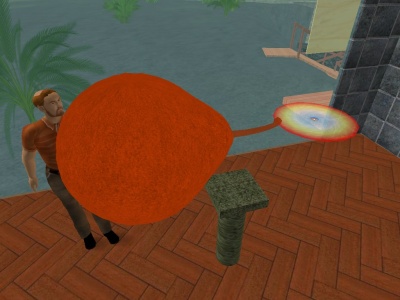
The traditional model we always used is show in the picture to the right. Indeed, when I’ve given talks about supernovae, or talks about Supernova Cosmology, I’ve shown this picture (or, in Second Life, the 3D object that I made) as our model for where these supernovae come from. Everybody showed a version of this picture. The idea was that you had a white dwarf star with a companion red giant (or other) star. The orbit of the two was close enough that its gravity could pull some of gas off of the outside of the companion star. That gas would then swirl around the white dwarf in an accretion disk, building up on the white dwarf. The white dwarf would eventually reach a critical mass of about 1.4 times the mass of the sun, and blow itself away in a runaway thermonuclear explosion that we would observe as a Type Ia supernova.
This seemed very reasonable. It’s not too hard to imagine how you’d get these systems. If you have a binary star system where the two stars aren’t the same mass— and we observe lots of those— one would “die” first, leaving behind a white dwarf. The second star would eventually reach its giant stage, puffing up and leaving its outer layers not terribly well gravitationally bound, and the white dwarf would have a relatively easy time pulling mass from it. This is still the model we have for regular novae. (With a regular nova, just the outer layers of the white dwarf explode in a nuclear fusion explosion, not the whole thing.)
But… modeling of these systems predict that they would emit a substantial fraction of X-rays. I don’t know exactly the details, but in brief, the center of the accretion disk gets extremely hot, and thus emits some X-rays. (Doubtless magnetic fields somehow get involved as well, but as I said, I don’t know the details.) What Chandra observed, however, was that there is not enough X-rays coming from galaxies for there to be enough of these accreting systems to explain the Type~Ia supernovae we see.
This leaves us with the conclusion that most Type~Ia supernovae must come from collisions of white dwarfs. (Or, possibly, from something else that we haven’t thought of yet.) And, to me, this is surprising, because I would have expected those collisions to be far rarer and harder to produce than the accreting systems I always thought that Type Ia supernovae came from.
I look forward to seeing more developments as the astrophysics community receives, thinks about, responds to, and does further investigation of this result.
1 Comment
Posted in Uncategorized |
Internet Astrophysics Celebs Carroll & Gay to Speak in Second Life
Posted on February 4th, 2010 — permalink
For those of you who haven’t been following my blog or watching my twitter or facebook updates, you may not realize that there are regular public-outreach astronomy talks in Second Life. These are designed for the general public, and are open to anybody. Indeed, because a Second Life account is free, they really are open to anybody. These talks are on Saturdays at 10 AM pacific time / 1 PM eastern time, are sponsored by the Meta-Institute of Computational Astrophysics, and are held in MICA Large Amphitheater of the StellaNova region in Second Life.
This series has historically been called “Dr. Knop Talks Astronomy”, because through the end of 2009 I have given the lion’s share of the talks. Indeed, I was thinking about it the other day. The last semester before I left Vanderbilt, I was contacted by the people who make the CD series called “The Great Courses”. These are CDs with lectures from university professors on their topics of expertise. Based on some podcasts of mine that were online from several years ago, they contacted me and asked me to come audition. The idea was that if I passed it, they might well produce a course from me. However, when I left Vanderbilt, and could no longer call myself a “Professor of Physics and Astronomy”, they were no longer interested in me.
It occurs to me that given the number of talks I’ve presented so far, those who have come to most or all of my talks have effective received the equivalent of one of these CD series on “hot topics in astronomy.” Indeed, it was more than that, for not only were there visuals (i.e. my slides), but it was interactive. You could ask questions, and also discuss the talk with the others present.
If you look at our schedule for this coming semester, you’ll see that we’re starting to mix things up some more. I’m still giving more of the talks than any other single person, but we’ve got a larger range of guest speakers. You can see who’s coming up soon by looking at the Upcoming Public Events page.
Last week, we had Nobel Prize winner John Mather speaking about the history of the whole Universe, and of hopes and plans for the upcoming Webb Space Telescope. In the next two weeks, we’ll have two “Internet Celebrities” talking. Sean Carroll, one of the authors of the popular physics blog Cosmic Variance, will be talking about his recently released book on the nature of time, From Eternity to Here. Then, Pamela Gay, host of 365 Days of Astronomy and a member of Astronomy Cast, will be speaking in two weeks.
Drop by and hear us. These talks can be very good… and, while you shouldn’t believe me if I tell you my own talks are good, others have told me that they are. The immersive environment of virtual worlds means that you really feel you are there— John Mather was commenting on this just last week after giving his talk.
Comments Off
Posted in Physics & Astronomy, Science, Second Life, Second Life Events |
On Technology and the Environment, Avatar, and Star Trek: Insurrection
Posted on January 25th, 2010 — permalink

Many have commented on the in-your-face social commentary of Avatar. Some have objected to the whole “white man’s burden” aspect, that the movie says the natives need a human to come in in order to save them. Others have pointed out the obvious contradiction of the movie’s blatant anti-technology message with the fact that this is a movie who’s very creation depending on cutting edge technology. I want to write about the latter here.
Specifically, I want to ask the question: is it even possible for a technologically advanced society to “remain in harmony with the environment”? I put that latter phrase in quotes, because it can mean a number of different things. I don’t want to fall into the whole wishy washy “mother Gaia”, we-must-not-disturb-any-blade-of-grass philosophy. Rather, I mean, is it possible for a technological society to exist without fouling its own nest? That is, without rendering the planet on which it emerges something that is less hospitable, or at the very least less pleasant to live on.
Avatar, admittedly with a sample size of one, says no. Humans are represented by technology. All of the colors of everything the humans do, with the exception of their explosions and their computer display screens, are grey. They’re represented by big buildings and big machines. They are industry and technology. In contrast, the Na’vi show a rainbow of colors in themselves, their dress, and the world they live in. They have low technology; they haven’t even picked up guns. (The only Na’vi we ever see shooting guns are avatars of humans.) They fully eschew technology and they live in complete harmony with their environment.
It’s an anti-progress message. Technology is bad, and without that you have the Noble Savage. Of course, this is a simplistic message, and it takes only the slightest of thought to realize that both messages cannot be completely true.
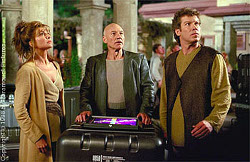
Which brings me to Star Trek: Insurrection. It wasn’t the greatest of Star Trek movies (although I’d rank it #2 out of the four Next Gen movies), but it did show something that we so rarely see in science fiction movies: a high-tech society that maintains its high tech, yet which evidently lives simply and in harmony with its environment.
The movie opens with a pastoral scene of an agrarian village living their happy, low-technology life. The camera pans back… into a hidden complex overlooking the village, with all kinds of people (in Star Fleet uniforms) watching them using high tech equipment. The room is dark, and the undertones of the music take on an ominous tone. We’ve all been through what Hollywood produced before, so we know how to react. Happy low-tech society comes into contact with nasty overbearing high technology; high technology, despite the Star Fleet uniforms, is evil. We know that only sadness can result from the interaction. (Well, except that this is Star Trek, so the happy good people have to win in the end.)
Things happen; Data (the android member of the crew) has something going wrong with him, and he ends up captured by the villagers. Picard and others costume themselves up in low tech clothes to go try to extract Data. Then the surprise comes. When they meet the villagers, one of them spews some technobabble, saying, “by the way, we fixed your android for you.”
What we’re seeing here is something we almost never see in Hollywood. It’s a high-tech society, that has not relinquished or forgotten about its technology, but that is living in harmony with its environment. Normally, Hollywood either glosses over it (as is the case usually in Star Trek), or technology is presented as something that inevitably leads to the destruction of the environment. It was really quite refreshing to see this, and to see the message that, hey, look, if you want to live the simple life, if you want to live in harmony with the environment, you don’t have to revert to the old days. You can maintain (say) medical technology that saves you from dying from a minor infection or saves you from permanent disfigurement from a broken bone. Too often, it’s presented as an either/or— if you don’t want to destroy your planet, you have to give up all of your technology. I reject that notion.
Coming back to Avatar, I have to admit that despite really liking the movie, I was a little disappointed in the “technology is evil” message. I honestly believe that it is at least in principle possible for a technologically advanced and advancing civilization to exist in such a way that it doesn’t ultimately render its planet ugly and less habitable. We haven’t fully done the experiment yet, but we’ve got one in progress. We have exactly one technologically advanced society to look at, and currently things aren’t looking so good. Based on the results of climate science, at best we can hope for expensive ongoing low-level environmental disasters in the next century as we adapt. I hope civilization manages to get through the next century or two, adapt to the problems we’ve created for ourselves, and eventually get things in balance again. But it’s entirely possible that things will be worse than that, that the pressures ultimately created by the climate change we ourselves have wrought are going to lead to very bad secondary social problems that severely mar civilization— and that’s not even considering the most dire predictions that come from climate scientists.
Climatology is hard enough that we don’t really know what will happen. But we know enough to know that there is an extremely strong probability that something will happen. Yet, the “debate”, at least in the USA, is caught up over whether or not we want to admit that the probability exists, over whether or not there were misdeeds on the part of some small fraction of the climate science community. We’re not really doing anything to mitigate the situation. I would have to say based on this sample size of one that the implicit contention of movies like Avatar— that technological civilizations ultimately foul their nest— appears to be correct. I’m not anti-technology, I’m decidedly pro-technology. But when I look at how we’re doing as a society as a whole, it’s hard to reject the movie as being baselessly “anti-technology”.
(Irrelevant afterward: another way to look at Avatar is that Pandora is in fact a high-technology society. It is the laboratory of a single, ancient, extremely vast and powerful being named Eywa, who has amazingly advanced biotechnology (including a biotechnological computer network). It’s bred the native species, and introduced DNA from somewhere else to create the Na’vi, combined with the DNA of the local species. Why are the Na’vi from somewhere else? Notice how all the animals of Pandora have six limbs. The land animals have six legs, the winged ones have four legs in addition to the two wings. But the Na’vi only have four limbs, and do not even have vestigial fifth and six limbs. This suggests that they have some ancestry that’s outside of the evolution of Pandora. Indeed, that outside DNA may well be from humans, collected by Eywa after she mutilated enough cattle to realize that they weren’t a good source. That explains why it was even possible for humans to create Na’vi avatars that they could transfer themselves into.)
3 Comments
Posted in Uncategorized |
Me in the Infrared
Posted on January 5th, 2010 — permalink
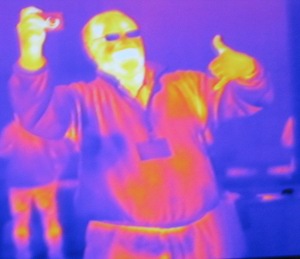
The Spitzer booth at the AAS has an infrared camera set up, so you can see what you look like in wavelengths just longward of one micron.
This is me:
I’ve got my mouth wide open in a jolly smile, which is why that part is glowing. Meanwhile, you can see that my glasses do not transmit infrared light as well as they transmit optical light, and are not as warm as my face, so they show up as dark spots.
1 Comment
Posted in Physics & Astronomy, Science |
How long does it take planets to form?
Posted on January 5th, 2010 — permalink
One thing that’s currently unknown— and there remain debates among the theorists and modellers— is how long it takes for planets to form. Timescales vary between 1 and 10 million years. What’s more, based on our understanding of the environments around very young stars, big gas giant planets have to form a fair distance away from the star (equivalent to where you find Jupiter and Saturn in our Solar System), yet we’ve found lots of Jupiter-sized planets very close to their star… so, our current understanding is that those planets not only have to form, but have to migrate in.
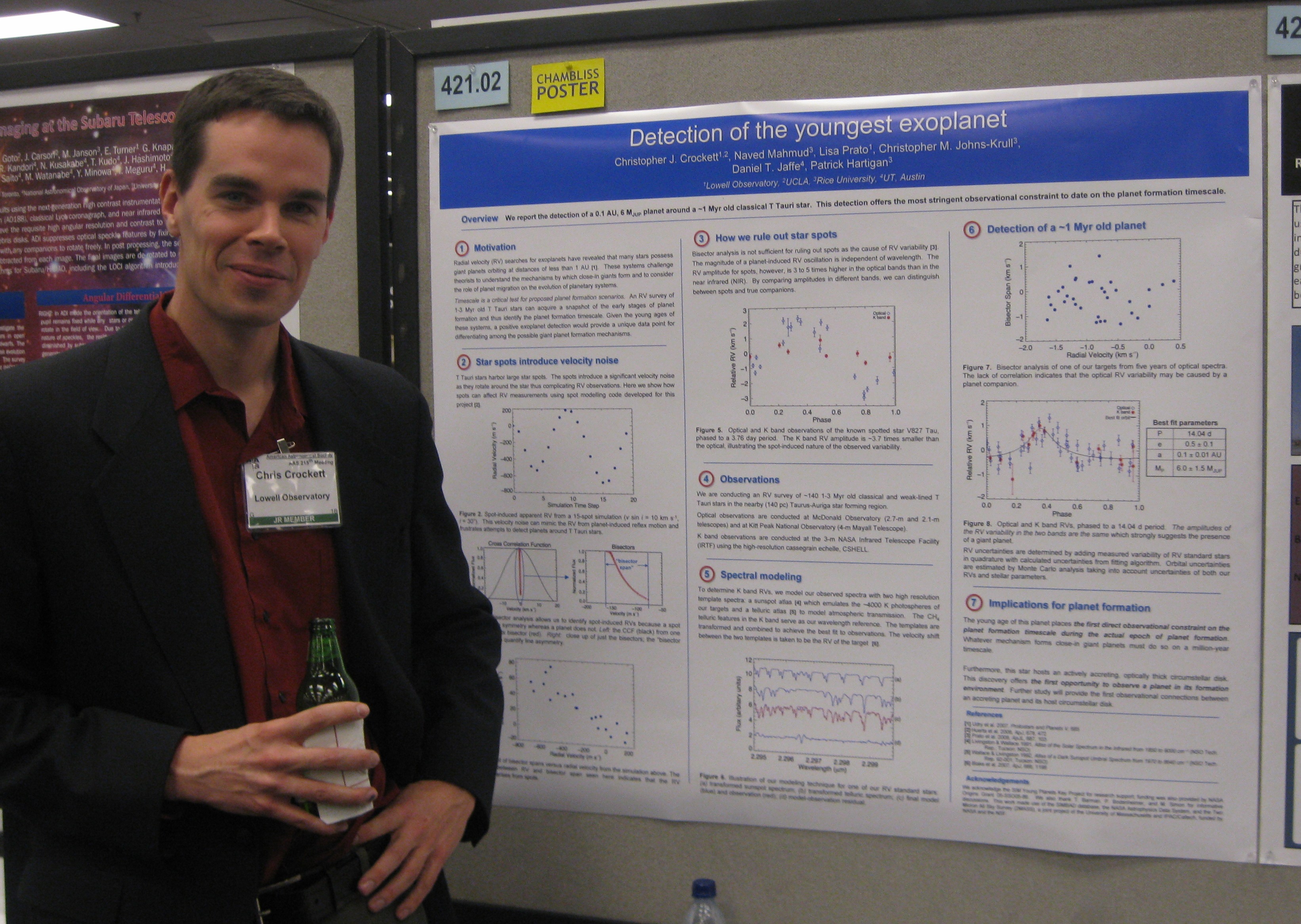
One thing that would help us figure out the timescale for planet formation is doing searches for planets around very young stars. Below is a poster that reports the discovery of the youngest exoplanet known:
Shown is graduate student Chris Crockett of Lowell Observatory. (And, if his advisor is looking at this, no, that’s not a beer!.) (Although, to be perfectly honest, I have to admit that the reason I sought out this particular poster is that the second author is Naved Mahmud, graduate student at Rice who worked with me at Vanderbilt, and who made one of the nicest comments a blogger could ever hope to get, so, see, flattery sometimes does get you somewhere!)
What they’ve discovered is a planet orbiting a Classical T-Tauri star. If you don’t know what that means, you’re like me… or, rather, you’re like me several years ago. However, I was at Vanderbilt for six years, where David Weintraub and his students were doing a lot of work on T-Tauri stars, so as a result I learned something about them. T-Tauri stars are stars like the Sun, only still in the late states of formation. They’re not protostars, really, any more, but they haven’t yet ignited fusion at their cores. They are what’s known as “Pre-Main Sequence” stars. (Yes, folks, that’s what astronomers think PMS means.) There are “Classical” and “Weak” T-Tauri stars, based on the strength of the Hα emission line. Our understanding is that the Hα results from accretion of gas on to the star— and Crockett et al. have more evidence to support this. What does this mean? There is still a substantial gas disk around the star, putting the protoplanetary disk almost certainly within the first million or two years of it’s life.
In other words: what these guys have discovered is a Jupiterish planetary mass condensed around a star that’s at most a couple of million years old. This is an extremely relevant constraint on how long it takes to form planets, and will be big news for those who try to theoretically understand the original formation of our Solar System and other planetary systems.
This work should be submitted to a journal sometime soon, and presumably sometime thereafter it will show up on arxiv.org.
Comments Off
Posted in Physics & Astronomy, Science |
Result from Kepler : a planet’s light blocked by a star
Posted on January 4th, 2010 — permalink
This morning the invited talk at the AAS meeting was William Bourucki of NASA/Ames talking about first results from the Kepler mission. The coolest thing he described was an object that’s too hot to be a planet, but too big to be the kind of star it could be…! More about that later.
Right now, I want to show my blurry snapshot of his plot of the lightcurve of an already-known exoplanet named HAT-P-7:
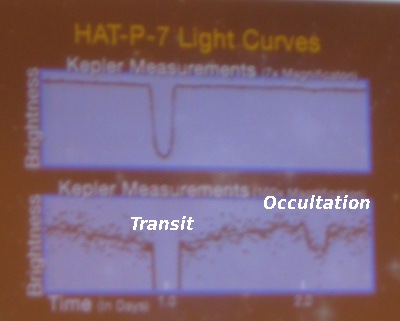
This is a plot of the brightness of the star versus time. This was a previously known planet. In the top, you see the Kepler data that results from when the planet transits the star. That is, the planet moves across the face of the star, blocking out a little bit of the starlight, causing the star to get just a wee bit dimmer. The planet is much dimmer than the star, so it only blocks out a bit of the starlight, but Kepler is sensitive enough that this is an extremely strong detection.
What’s cool is when you zoom in on the plot. You see a second dip to the right. What you’re seeing there is the light of the planet being blocked by the star. The planet shows reflected light from the star, which adds to the overall light you see. However, when the planet is occulted by the star, you no longer see that reflected light… and you get a secondary dip.
A number of extrasolar planets have been detected by looking for stars whose light is briefly blocked out due to an orbiting planet moving in front of the star. Kepler is a spacecraft designed to find lots of these planets. It’s really cool that it’s sensitive enough that it’s seeing the light of a planet blocked out by a star…!
Comments Off
Posted in Physics & Astronomy, Science |
AAS Astronomy Events Live Streamed into Second Life
Posted on January 4th, 2010 — permalink
I’m at the annual big meeting of the American Astronomical Society this week in Washington, DC. Lots of stuff going on, and I’m already overwhelmed by the sheer number of people here. (And, also, depressed by the number of young people here in comparison to the number of entries on this list.
Several of the bigger events— press conferences, invited talks— are going to be live streamed into Second Life. Drop by the Astronomy 2009 island to hear the talks, including the Wednesday at 8AM Eastern / 5AM Pacific talk by astronaut and Hubble Mechanic John Grunsfeld. These events are hosted by Astronomy 2009 and by the Astrosphere New Media (Pamela Gay’s and others’ new venture). A full schedule is here.
Remember that a Second Life account is free! Drop by and check it out. And, once you’ve got a Second Life account, nothing will be stopping you from coming to hear my public astronomy talks that I frequently give.
1 Comment
Posted in Physics & Astronomy, Science, Second Life, Second Life Events |